 smith
Imagery & symbolism (Rider–Waite–Smith)
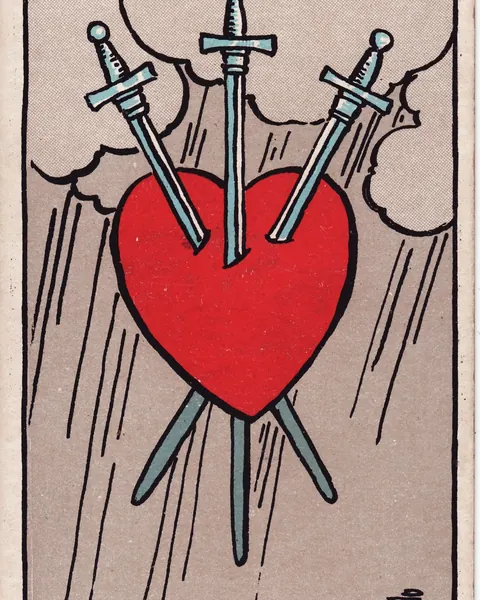
In the Rider–Waite–Smith deck, drawn by Pamela Colman Smith in 1909, the Three of Swords is one of the simplest images among all 78 cards. There is no figure, no landscape and no story unfolding. A red heart floats against heavy grey clouds, three swords pass cleanly through it, and slanted rain falls across the whole scene. Because nothing distracts from that central picture, most people understand the card the moment they see it.
Even so, it helps to read the image symbolically rather than literally. The heart stands for feeling, affection and hope, not for the physical body. The swords belong to the suit of Air, which governs thought, speech and truth. Put together, the picture describes a moment when words, ideas or a sudden realisation touch something you care about deeply. And rain, in almost every tradition, is also an image of washing clean.
- The red heart: love, loyalty and expectation, the things we hold closest. It hurts precisely because it mattered.
- Three swords: a sharp remark, a fact you have just learned, or a thought you keep repeating to yourself. The number three is also read as a third party or a triangle of competing loyalties.
- Storm clouds: the heavy mood that settles over everything when you are sad.
- Falling rain: tears, and also cleansing. Rain is gloomy while it falls, yet it leaves the air fresher once it stops.
- The empty background: when grief is strong, it can be hard to notice anything else, and the card shows that narrowed focus honestly.
Upright
Upright, the Three of Swords points to a hurtful event or an unwelcome insight. It might be disappointing news, a plan that fell through, a careless comment from someone close, or a truth you had been avoiding that finally became impossible to ignore. The card does not exaggerate any of this. It simply acknowledges that the hurt is real, and in doing so it gives you permission to say so instead of pretending you are fine.
As a Swords card, the pain here is often linked to clarity. Some things are comfortable only as long as we do not know them. Once they are known, they sting. Yet knowing also means you can now choose with accurate information rather than hope or guesswork. The ache is a turning point, not a final verdict on your life or your worth.
The card's advice is gentle and practical: let the feeling move through you instead of locking it away. Talk to someone you trust, write down what happened in your own words, cry if you need to, and give yourself ordinary comforts such as rest, warm food and fresh air. Grief that is acknowledged tends to soften; grief that is ignored tends to linger.
Reversed
Reversed, the Three of Swords is often read as the rain beginning to ease. A wound starts to close, and you find you can look back at what happened with a little more distance. The memory may still carry a scar, but recalling it no longer takes your breath away. This is the slow, unglamorous stage of recovery where small good days start to outnumber the hard ones.
A second reading is grief that is being held in rather than released. Keeping busy, changing the subject or insisting that it does not matter can make an old hurt last longer than it needs to. If this card appears reversed, ask yourself honestly whether you are healing or simply covering things up. If a heavy mood has stayed with you for a long time, reaching out to a friend, a counsellor or another qualified professional is a sensible and caring step.
Love
In love readings, the Three of Swords describes hurt feelings: a misunderstanding, an argument, a sense of being let down, or the sadness that follows a break-up. It does not decide that a relationship must end. Many couples find that naming a painful issue openly is exactly what allows them to clear the air and grow closer, while others realise it is time to part kindly.
Because the number three can suggest a third person, some readers also see jealousy or divided attention in this card. Treat that as a question to explore calmly, not as an accusation.
| Situation | Upright | Reversed |
|---|---|---|
| Single | An earlier heartbreak may still make it hard to open up to someone new. There is no rush; rebuild your own sense of security first. | The ache is fading and curiosity about meeting people returns. Let what you learned last time guide you, and take things slowly. |
| In a relationship | A remark or a misunderstanding may have bruised one of you. Rather than assigning blame, describe calmly what hurt and why; that usually opens a path forward. | Small disappointments have been stored up unspoken. Raising them gently now is kinder than waiting until they grow larger. |
| Reconciliation & breakups | This is when the sadness of the split feels strongest. Before thinking about getting back together, give yourself time to sort through what you feel. | The pain is easing, and you can look at the relationship with calmer eyes. Whether you reconnect or move on, the decision will feel steadier. |
Money
In money matters, the Three of Swords usually reflects disappointment: income that turned out lower than expected, a purchase that was not what it promised, or a plan that simply did not work as hoped. The card asks you to look at what happened clearly and without self-blame, so that you understand what went wrong rather than just feeling bad about it.
Emotional periods can also shake financial judgement. Watch for comfort spending meant to soothe a low mood, and equally for freezing up and cancelling things you genuinely need out of worry. Reversed, the card suggests you are recovering from a setback and are ready to make a fresh, realistic plan. Whenever larger sums are involved, it is wise to wait until your feelings have settled, and to rely on qualified advice rather than on any card.
Career & study
At work, this card often appears around hurtful feedback, a promotion or project that did not happen, or friction with a colleague. Frequently it is not the work itself but the way something was said that stays with you. The Three of Swords suggests separating the facts from the feelings: keep any useful point hidden inside the criticism, and give the sting its own separate care.
In study, it can describe the letdown of an exam result or an application that did not go your way. Disappointment is a natural response, so allow yourself to feel it. Once the first wave passes, choose just one concrete thing you will change next time, whether that is your timetable, your study method or the support you ask for.
Reversed, the card shows you finding the energy to try again. The experience that hurt can become useful material for the next attempt, and many people find their second try is steadier precisely because they know where the weak points were.
As your card of the day
Drawing the Three of Swords as your card of the day does not mean something bad is about to happen. It is better read as a reminder to treat yourself with a little more kindness today, because small slights might land harder than usual.
If something painful has already happened, today does not have to be the day you fix it. Spending time simply acknowledging the feeling is worthwhile. Emotions often shrink once they are given a name.
- Try: writing a few honest lines about what is bothering you, eating something warm and resting properly, and talking with someone who listens well.
- Go easy on: sending messages while you are upset, or answering a hurtful comment with another one.
- One-line advice: admitting that something hurts is already the first step towards healing.
Card combinations
- Three of Swords + The Star: healing and renewed hope after a painful time; the sky clears and you begin to trust again.
- Three of Swords + Five of Cups: loss layered on loss. It is easy to dwell on what has gone, so remember to look at what still remains.
- Three of Swords + The Lovers: choice and heartache are tangled together, which may point to divided feelings or a triangle that needs honest, careful handling.
- Three of Swords + Six of Swords: carrying the hurt with you, yet moving steadily towards calmer water.
- Three of Swords + Four of Swords: after the storm, rest. Recovery comes through quiet time rather than immediate action.
The number 3 in the suit of Swords
Three is the number at which something first shows itself as a result. In the Three of Wands, plans reach outward; in the Three of Cups, joy is shared among friends. In Swords, the suit of thought and truth, the result arrives as a feeling that lands in the heart. You can see it as the moment when the decision postponed in the Two of Swords, or the fact you were not ready to look at, finally comes into view.
The Golden Dawn named this card the Lord of Sorrow and assigned it to Saturn in the second decan of Libra. Saturn is the planet of limits, time and lessons learned the slow way, so the sorrow of this card is not treated as pointless suffering. It is pain that teaches something over time. Just as ground firms up after rain, the story of the suit moves naturally from here into the rest and recovery of the Four of Swords.