 smith
Imagery & symbolism (Rider–Waite–Smith)
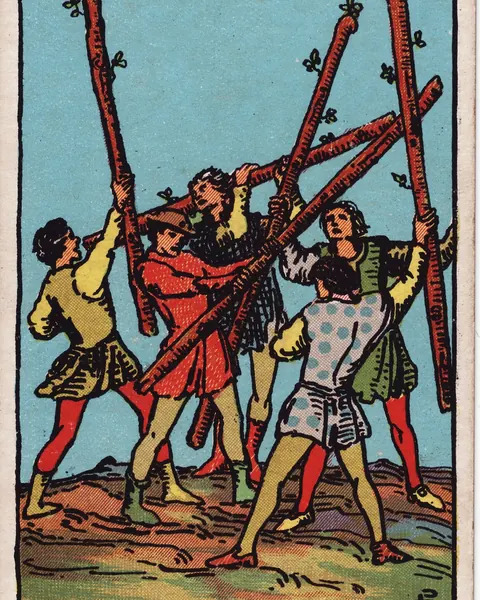
The Rider–Waite–Smith Five of Wands shows five young men on open ground, each holding a long wooden staff. They are raising their wands at different angles, some crossing, some pointing upward, as if in the middle of a scuffle. Each wears a different outfit in different colours, and the background is a plain, pale blue sky with little else to distract from the action.
Look closely, though, and the scene is oddly bloodless. No one is wounded, no one has fallen, and the faces are more focused than furious. Many readers interpret it as a mock battle, a game, a training session or a heated debate rather than a real war. That ambiguity is the heart of the card: friction that can either sharpen everyone or exhaust everyone, depending on how it is handled.
- Five crossed staves: competing ideas and agendas. Everyone has a point to make, and the staves rarely line up in the same direction.
- Different clothes for each youth: different backgrounds, styles and opinions. The conflict comes from diversity, not from villainy.
- No injuries, no winner yet: this is a contest still in progress. It can be playful sparring as much as genuine opposition.
- Young figures: energy, ego and inexperience. The clash may be a sign of growth, the kind of struggle you go through while learning.
- The empty background: nothing else matters in the moment. Conflict tends to fill the whole field of vision while it lasts.
Upright
Upright, the Five of Wands describes competition and friction. It often appears when you are in a crowded field, such as a job application with many candidates, a team where everyone wants to lead, a group chat full of opinions or a market with many rivals. The energy is busy, loud and sometimes chaotic.
In the Golden Dawn system it is the Lord of Strife, Saturn in the first decan of Leo. Leo wants to shine, express itself and be recognised; Saturn imposes limits, delays and tests. Put together, they describe the frustration of having plenty of fire but meeting resistance at every turn. Saturn's lesson is that the resistance is shaping you. You learn your real strengths when you have to defend them.
This card does not have to be negative. Healthy competition pushes people to improve, debate generates better ideas and a bit of rivalry can make a game worth playing. The upright Five asks you to engage rather than retreat: say what you think, show what you can do and accept that not everyone will agree.
At the same time, notice whether the struggle is productive. If everyone is talking and no one is listening, the energy is being wasted. Setting simple ground rules, such as taking turns, defining a shared goal or agreeing on how a decision will be made, can turn a scramble into a real contest of ideas.
Reversed
Reversed, the Five of Wands usually points to the end, or the avoidance, of conflict. In a positive sense, a long-running dispute may finally be settling, people are ready to compromise, or a draining rivalry is losing its heat. You may decide that some fights are simply not worth your energy.
In a less helpful sense, the reversal can describe conflict that has gone underground. Rather than open debate, there is passive aggression, silence or resentment that never gets spoken. Avoiding a disagreement does not always resolve it; sometimes it just moves the tension somewhere less visible.
The card can also turn inward. You may be fighting with yourself, torn between competing desires, values or plans, and wearing yourself out in the process. Writing down the different voices in your head, and what each one actually wants, can help you find common ground within.
Occasionally it warns that a disagreement is close to becoming personal. If arguments have shifted from ideas to insults, it is time to step back, cool down and return when everyone can listen again.
Love
In love, the Five of Wands shows friction, rivalry or a lot of mixed signals. It can describe bickering in a relationship, competition for someone's attention or simply the playful sparring some couples enjoy. The key question is whether the tension is energising or exhausting.
| Situation | Upright | Reversed |
|---|---|---|
| Single | You may have competition for someone's interest, or dating feels chaotic with many options and little clarity. Stand out by being yourself rather than trying to win at all costs. | You may be tired of games and ready to step away from confusing situations. That is healthy; clarity is more attractive than drama. |
| In a relationship | Small disagreements and power struggles are flaring up. Treat them as a sign that you both care, and learn to argue fairly: about the issue, not about each other. | Arguments may be settling, or they may be going unspoken. If you have stopped fighting because you have stopped talking, gently reopen the conversation. |
| Reconciliation & breakups | Old conflicts may resurface if you reconnect. Ask whether the issues that caused the breakup have actually changed before trying again. | You may be ready to drop the blame and make peace, whether or not you get back together. Letting go of the fight can free you either way. |
Money
Financially, the Five of Wands suggests competition for resources. Prices might be pushed up by demand, there may be several people bidding for the same thing, or you could be negotiating hard over money. It can also describe disagreements about money within a household or group.
The best approach is calm and organised. Know your limits before entering a negotiation, compare options carefully and do not let the heat of competition push you into overspending just to win. Reversed, the card can indicate disputes being settled or a decision to step back from a costly contest. Sometimes the wisest financial move is to leave a bidding war.
If shared money is causing friction, write down who pays for what. Clear agreements reduce misunderstandings far more than heated discussions do.
Career & study
At work, the Five of Wands is the card of a competitive environment. You may be up against other candidates for a position, pitching against rival companies or working in a team where personalities clash. It is not a sign of failure; it is a sign that you need to show your skills clearly and hold your ground.
The card also describes brainstorming and creative debate. Meetings may be loud and messy, but the best ideas often emerge from exactly this kind of friction. Contribute constructively, listen as well as speak and help turn the chaos into a plan.
For students, the card can point to competitive exams, group projects with disagreements or debates in class. Use competition as motivation rather than as a source of anxiety. Reversed, it may show a group finally cooperating, or a decision to stop comparing yourself to others and focus on your own progress. Both are healthy shifts.
As your card of the day
When the Five of Wands is your card of the day, expect a bit of friction and choose your battles wisely. Some disagreements are worth engaging with because they lead to better solutions; others are just noise. Stay flexible, keep your sense of humour and do not take every challenge personally.
- Try: joining a discussion with a clear, calm point, or channelling restless energy into a game or workout.
- Watch out for: arguing simply to win, or letting a minor disagreement spoil your whole day.
- One-line advice: Spar to sharpen yourself, not to wound anyone.
Card combinations
- Five of Wands + Justice: a conflict settled by fair rules or mediation. Once clear standards are set, the quarrel can end.
- Five of Wands + The Chariot: despite the competition, willpower and focus can carry you ahead.
- Five of Wands + Temperance: finding a middle way between opposing views. Compromise is the answer.
- Five of Wands + Six of Wands: victory after a hard-fought contest. The current friction is only part of the process.
- Five of Wands + Two of Cups: tension that can be eased through honest, one-to-one conversation.
The number 5 in the suit of Wands
In tarot numerology, five is the number of disruption and change. After the stable structure of the four comes something that knocks it off balance. Every Five in the Minor Arcana shows a challenge: loss in the Five of Cups, conflict and pride in the Five of Swords, hardship in the Five of Pentacles. These cards are uncomfortable, but they are also where growth happens.
For Wands, the suit of energy and ambition, that disruption appears as competition. After the comfortable celebration of the Four, the fire meets other fires. Everyone wants space to express themselves, and not everyone can lead at once.
In the wider story of the suit, the Five is the gateway to the Six of Wands' victory and the Seven's determined defence. You cannot win recognition without first being tested, and the Five is where that testing begins. Seen this way, the card is not a punishment but a training ground. The skills, confidence and resilience you build in this noisy middle stage are exactly what will allow you to ride in triumph later.