 smith
Imagery & symbolism (Rider–Waite–Smith)
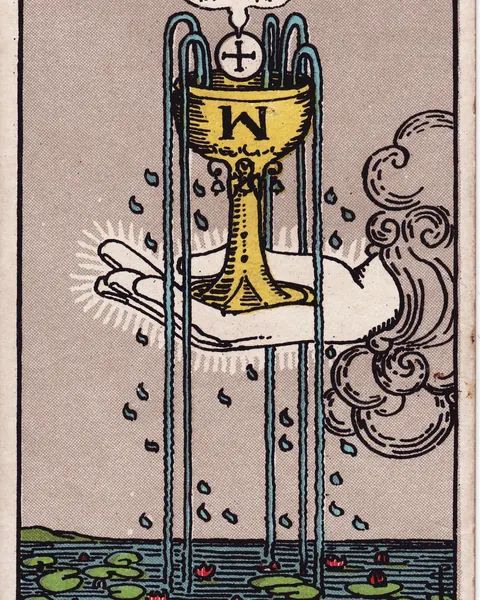
In the Rider–Waite–Smith deck, a hand emerges from a cloud on the right side of the card and offers a golden chalice. Five streams of water pour over its rim and fall into a pond below, which is covered with water lilies. A white dove dives toward the cup, holding a small wafer marked with a cross, and droplets shaped like the Hebrew letter yod scatter through the air around it.
Like every Ace, this card shows a gift being handed to you rather than something you have built yourself. With the Ace of Cups the gift is emotional: an open heart, a surge of compassion, the first flush of love or the quiet sense that something wounded inside you is starting to heal. The cup is so full that it cannot help spilling over, and that overflow is the heart of its meaning.
- The cup held out from a cloud: love, kindness or inspiration that arrives as grace. You do not have to earn it; you only have to be willing to receive it.
- Five streams of water: often linked with the five senses. Feeling is not abstract here; it moves through your whole body and your experience of the world.
- The dove and wafer: a symbol of peace and spirit descending into everyday life. Many readers see it as a sign that this emotion has a spiritual or healing dimension.
- The falling yods: drops of divine blessing in the Golden Dawn tradition. The same little flames of grace appear on cards such as The Moon and the Tower.
- Water lilies on the pond: emotions taking root and blossoming. What begins as a single feeling can grow into something lasting and beautiful.
- The letter on the cup: the chalice bears a sign often read as an inverted M or a W, interpreted by different authors as a reference to water or to the Hebrew letter mem. Either way it stresses that this is the cup of the Water element.
Upright
Upright, the Ace of Cups is the beginning of a new emotional chapter. It frequently appears at the start of a relationship, when you meet someone and feel unusually seen, but it is just as relevant to friendships, family bonds and the relationship you have with yourself. Its core message is that your heart is ready to open, and that it is safe to let feeling in.
The card often brings a sense of relief or renewal after a dry season. You may find yourself moved to tears by a song, touched by a stranger's kindness or suddenly forgiving someone you had been holding at arm's length. Those moments are the Ace at work: emotion flowing again where it had been blocked.
In the Golden Dawn system the Ace is called the Root of the Powers of Water. It is not placed in a single decan; instead it represents the source of Water as a whole, standing behind the three Water signs, Cancer, Scorpio and Pisces. That is why it can carry the nurturing quality of Cancer, the depth of Scorpio and the compassion and imagination of Pisces all at once.
Traditionally the Ace of Cups is also associated with fertility, new life and creative inspiration, especially work that comes straight from the heart, such as music, poetry or art. Intuition tends to be strong under this card. If you have a quiet sense about a person or a choice, it is worth listening to.
The practical advice of the upright Ace is simple: receive. Say yes to the invitation, accept the compliment, let someone help you. The cup is already being offered; the only question is whether your hands are open.
Reversed
Reversed, the Ace of Cups shows a cup that has tipped over or been turned away. The most common reading is emotional blockage: feelings you are not allowing yourself to have, or a love you want but do not feel able to receive. You might be telling yourself you are fine while feeling oddly empty inside.
It can also describe emotional dryness after a period of giving too much. If you have been caring for everyone else, the reversed Ace may say your own cup is nearly empty. Before you can pour for anyone else, you need to let something refill you, whether that is rest, time with people who replenish you or simply honest acknowledgement of how tired you are.
Some readers see the reversed Ace as the opposite extreme: feelings spilling out without any container. Moods swing, reactions are bigger than the situation calls for, or you pour your heart into someone who is not ready to hold it. Here the advice is not to shut down but to find a gentle structure, such as journaling, talking with a trusted friend or giving yourself time before responding.
In love questions, the reversed Ace can point to unrequited feelings, a romance that does not quite begin or a reluctance to commit because of past hurt. None of this is permanent. The cup is still there; it is just facing the wrong way for now, and turning it upright again often starts with being honest with yourself about what you feel.
Love
In love readings the Ace of Cups is one of the warmest cards in the deck. It speaks of genuine emotional openness rather than surface attraction, and it favours relationships in which both people feel able to show their soft side.
| Situation | Upright | Reversed |
|---|---|---|
| Single | New love is likely, or a connection that feels emotionally real from the start. Someone may surprise you with their kindness. Keep your heart open and let things unfold. | You may like someone but struggle to show it, or past hurt makes you guarded. Work on your own heart first; the right connection is easier to recognise when you are not braced against it. |
| In a relationship | Feelings deepen and renew. This can be a time of tender gestures, heartfelt conversations, a new level of commitment or even news of a pregnancy or a new home together. | Affection has gone quiet or one of you is holding back emotionally. Gently ask what is missing instead of assuming the love is gone. |
| Reconciliation & breakups | A softening of hearts is possible. If contact resumes, it may begin with sincere apology or simply warmth that was always there underneath. | Lingering feelings may be one-sided or tangled with regret. Healing yourself may matter more than trying to restart the relationship right now. |
Money
With money, the Ace of Cups is less about numbers and more about how you feel about what you have. It can point to a gift, a generous gesture, help from someone who cares about you or an opportunity that arrives through a personal connection. Income tied to work you love, such as creative, caring or hospitality work, is especially favoured.
The card also invites you to notice emotional spending. If you buy things to fill an emptiness or to cheer yourself up, the Ace asks what you are really thirsty for. Reversed, it may describe money leaking away through comfort purchases or a reluctance to look at your finances because they make you anxious. A gentle, non-judgemental review of where your money goes can feel surprisingly freeing.
Upright, the Ace is also a reminder that generosity flows both ways. Sharing a meal, giving a thoughtful gift or helping a friend without keeping score tends to bring good feeling back into your life, even if it does not show up on a balance sheet.
Career & study
At work, the Ace of Cups favours jobs that feed the heart: caregiving, counselling, teaching, the arts, hospitality, design and any role where empathy is an asset. It can signal a new position you feel genuinely excited about, a supportive team or a project that reminds you why you chose your path in the first place.
If you have felt burned out, this card may mark a return of meaning. It can also suggest that relationships at work are the key: a manager who appreciates you, a colleague who becomes a friend or a client who values what you do. Let your sincerity show; it is more persuasive than you think.
For students, the Ace points to a subject you truly love or a renewed emotional connection with your studies. Learning goes better when you care, so look for the part of the material that moves you. Reversed, it can describe emotional exhaustion or losing touch with why you are studying at all. Rest and small rewards may help more than pushing harder.
As your card of the day
When the Ace of Cups turns up as your daily card, the day invites you to feel rather than to analyse. Notice what touches you, who you feel close to and where you could offer a little kindness without being asked. A small gesture today can mean more than you realise.
- Try: sending a warm message to someone you have been thinking about, or doing one thing purely because it makes you happy.
- Watch out for: hiding a real feeling behind politeness or a joke.
- One-line advice: An open hand can receive what a closed fist cannot.
Card combinations
- Ace of Cups + The Lovers: a heartfelt beginning that leads to a meaningful choice or commitment. A beautiful pairing for new love.
- Ace of Cups + The Star: healing and hope after a difficult time. Your heart is recovering, and faith in the future returns.
- Ace of Cups + Ten of Cups: a new emotional start that grows into family happiness or a deep sense of belonging.
- Ace of Cups + Five of Cups: grief and renewal side by side. Something was lost, but a new source of feeling is already being offered.
- Ace of Cups + Two of Cups: mutual feelings. The emotion you sense is likely being returned, making this a hopeful pair for relationships.
The number 1 in the suit of Cups
In tarot numerology, one is pure potential: the moment before anything divides, compares or forms a relationship. Every Ace holds its whole suit in seed form. Inside the Ace of Cups is the meeting of the Two, the celebration of the Three, the boredom of the Four, the grief of the Five and, eventually, the lasting happiness of the Ten.
Read as a story, the suit of Cups follows the life of feeling. It begins with this spontaneous overflow, moves into connection and community, meets disappointment and fantasy in the middle cards, and ends with the contentment of the Nine and the shared joy of the Ten. The Ace reminds you where all of that comes from: a heart willing to be touched.
Compared with the other Aces, the Ace of Wands brings a spark of drive, the Ace of Swords brings clarity and the Ace of Pentacles brings material opportunity. The Ace of Cups is the one that asks how you feel. It is less concerned with what you will achieve than with whether you will let yourself love, be loved and be moved by life.