 smith
Imagery & symbolism (Rider–Waite–Smith)
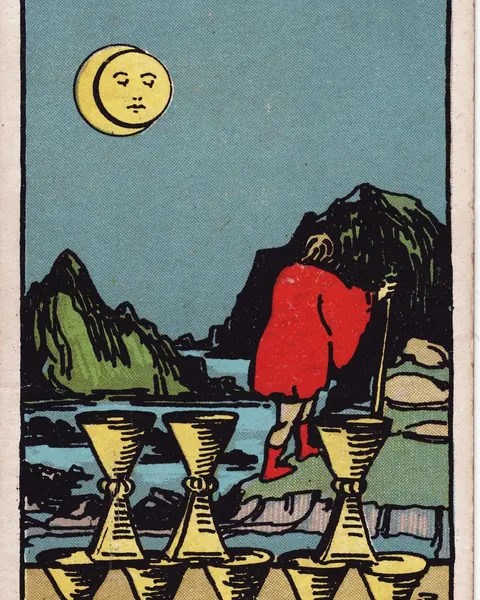
In the Rider–Waite–Smith deck, a figure in a red cloak, leaning on a walking staff, climbs away from the viewer toward rocky hills. In the foreground stand eight cups, stacked five on the bottom and three on top, with a visible gap where a ninth might fit. Above, the moon appears as both a full disc and a crescent at once, its face turned down with closed eyes, watching over the night journey. A stream runs between the cups and the mountains.
Nothing in the scene has been broken or spilled. The cups are upright and carefully arranged; the traveller simply leaves them behind. That is what makes the Eight of Cups so poignant. It is not about running from disaster but about quietly admitting that something which once mattered no longer feeds the soul.
- The eight stacked cups: what you have built emotionally, such as a relationship, a job or a way of life. Orderly, yet somehow incomplete.
- The gap in the stack: the missing piece. Something essential is absent, even though everything looks fine from outside.
- The red-cloaked traveller: will and courage. Red is the colour of action, and this person is choosing to move.
- The walking staff: endurance for a long road. The journey ahead is uphill, but the traveller is prepared.
- The eclipsed moon: intuition and the hidden pull of the unconscious. Some readers see the full and waning moon together as a cycle ending and turning.
- The barren hills: the unknown. There is no promise of comfort ahead, only the hope of meaning.
Upright
Upright, the Eight of Cups is the card of walking away. It often appears when you realise that a situation you have invested in, emotionally or practically, has stopped giving you what you need. You may not be able to name exactly what is missing. You only know that staying would mean pretending.
Its astrology is Saturn in Pisces. Pisces is the most dreamy and spiritual of the Water signs, longing for something beyond the everyday. Saturn brings sober reality, limits and endings. Together they describe a mature, sometimes melancholy decision: accepting that a dream has run its course and choosing to search elsewhere.
This card takes courage. Leaving the familiar is hard, especially when the cups are not broken and others may not understand why you would go. The Eight of Cups says that your inner truth matters more than appearances. If something is no longer alive for you, it is honest to let it go.
The departure is not always literal. It can be an inner turning away from a habit, a belief or a role you have outgrown. Many readers also link the card with spiritual seeking, solitude and retreat, a time to step back from the crowd and ask what you are really looking for.
The Eight of Cups is rarely impulsive. It usually follows a long period of doubt, as shown in cards like the Four of Cups. When it appears, the decision has often already been made somewhere inside you.
Reversed
Reversed, the Eight of Cups often describes being unable to leave. You know something is not working, yet fear, guilt or habit keeps you in place. You may keep telling yourself it will improve, or that leaving would be selfish. The card asks you to look honestly at what staying is costing you.
It can also mean the opposite: leaving too quickly, or running away instead of dealing with what is in front of you. If you tend to walk out whenever things get difficult, the reversed Eight asks whether this departure is truly about growth or about avoiding discomfort.
Sometimes the reversed card shows a return. The traveller turns back, perhaps because something they left has changed, or because the journey taught them to value what they had. Coming back is not a failure if it is a conscious choice rather than a retreat into the familiar.
Finally, the reversed Eight can describe indecision: one foot out the door, the other still inside. Living in that halfway place is exhausting. Clarifying what you need, in writing if it helps, is often the first step toward choosing a direction.
Love
In love readings, the Eight of Cups often points to emotional withdrawal or a decision to leave a relationship that no longer feels fulfilling. It can also describe one partner pulling away to search for themselves. It is a card of honesty about what the heart needs.
| Situation | Upright | Reversed |
|---|---|---|
| Single | You may be stepping back from dating to understand what you really want. Taking a break from relationships that keep repeating the same pattern can be healthy. | You may be stuck chasing someone or a type of relationship that never satisfies you. Ask what keeps drawing you back. |
| In a relationship | Something feels missing, and one of you may be emotionally distancing. Talk honestly about it before the distance becomes a departure. | Fear of change may be keeping you in a situation that feels empty, or you may be considering returning to the effort after a period of distance. |
| Reconciliation & breakups | Walking away may be the right choice, even if it hurts. You are leaving to find something more aligned with who you are now. | A return is possible, but make sure it is based on real change rather than loneliness or habit. |
Money
Financially, the Eight of Cups may point to leaving a stable but unfulfilling source of income in search of more meaningful work. It can also describe walking away from an investment, project or financial arrangement that no longer serves you.
Because this card often involves transition, it is wise to prepare before making big changes. Building some savings, researching options and having a practical plan can make the leap less stressful. Reversed, it may warn of staying in a draining financial situation out of fear, or of leaving abruptly without considering consequences.
The card is a reminder that money alone cannot fill the gap in the stack of cups. If you are earning well but feel empty, the answer may lie in values and purpose rather than income. This is general reflection, not financial advice.
Career & study
At work, the Eight of Cups commonly appears when you are thinking of leaving a job, changing careers or stepping away from a long-term project. The role may be stable, even successful, yet no longer meaningful. The card supports the search for work that aligns with your values.
Before you resign, consider whether a sabbatical, a change of department or a new skill could address what is missing. Sometimes the departure is inner, a shift in how you relate to your work. Reversed, it can show fear of leaving or feeling trapped. Small, practical steps toward an alternative can make change feel less overwhelming.
For students, the Eight may describe changing majors, leaving a course or taking a gap year to rethink your direction. It can also describe moving away from home to study. Reversed, it may reflect hesitation about a change you sense is necessary.
As your card of the day
When the Eight of Cups is your daily card, take a quiet moment to ask what no longer serves you. You do not have to make a dramatic decision today. Simply noticing what feels empty is a valuable first step.
- Try: taking a solitary walk and reflecting on what you are ready to let go of.
- Watch out for: staying in something out of guilt, or running from something out of fear.
- One-line advice: Leaving can be an act of faith in what you have not found yet.
Card combinations
- Eight of Cups + The Hermit: a deep period of solitude and soul-searching. Retreat to find inner wisdom.
- Eight of Cups + Six of Swords: moving on to calmer waters. A transition toward peace.
- Eight of Cups + Nine of Cups: leaving something behind leads to genuine contentment later.
- Eight of Cups + The Tower: a sudden event forces a departure that was already brewing.
- Eight of Cups + Four of Cups: long-standing dissatisfaction finally becomes a decision to leave.
The number 8 in the suit of Cups
Eight is the number of movement and transition. After the testing of the Seven, the Eight brings change, often through effort or a decision. In the Cups suit, that movement is emotional and spiritual: leaving the familiar to seek a deeper truth.
Other Eights show different kinds of movement. The Eight of Wands is swift action, the Eight of Swords feels trapped by thought and the Eight of Pentacles is steady practice. The Eight of Cups is the slow, deliberate walk away from emotional comfort toward meaning.
In the story of the suit, the Eight follows the fantasies of the Seven. Having seen many dreams, the seeker realises that none of the floating cups is enough and sets out to find what is real. The next cards, the Nine and the Ten, show the fulfilment that can follow such honest searching.