 smith
Imagery & symbolism (Rider–Waite–Smith)
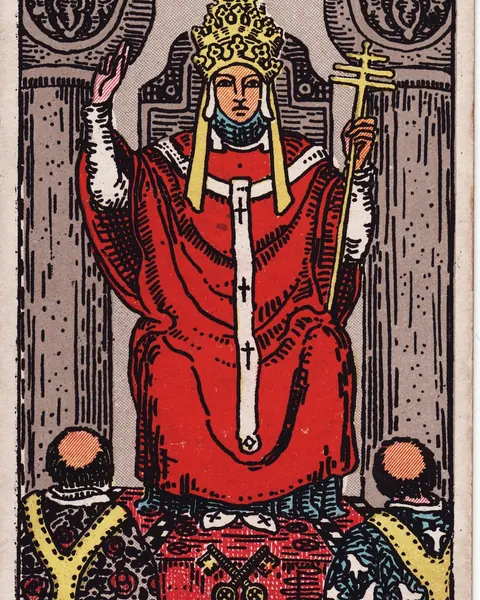
In the Rider–Waite–Smith deck the Hierophant sits between two grey pillars, much like the High Priestess, but the setting is now a formal temple rather than a veiled threshold. He wears a triple crown and red vestments, raises his right hand in a gesture of blessing with two fingers lifted, and holds a triple cross in his left. Two crossed keys lie at his feet, and two tonsured acolytes kneel before him, one wearing robes patterned with roses, the other with lilies.
The scene is about transmission. Knowledge is not discovered alone in a cave, as with the Hermit later on; it is handed down within a community, through rituals, lessons and shared language. Older decks called this card the Pope, and its imagery still echoes formal religion, but in modern readings it covers any established system of learning or belief: schools, professions, cultural traditions, family customs.
- The two pillars: like the High Priestess's pillars, a threshold between worlds, but here the knowledge between them is taught openly rather than hidden.
- The triple crown and triple cross: authority over several levels of life, often read as body, mind and spirit, or the physical, emotional and spiritual worlds.
- The blessing hand: two fingers raised, two lowered, a sign of what is seen and what is unseen, and of guidance offered to others.
- The crossed keys: access to knowledge and to the inner doors of understanding. The keys are given to those who learn.
- The two kneeling students: disciples, apprentices, the next generation. Wisdom only matters if it is passed on.
- Roses and lilies on their robes: desire and purity, the same pair that grew in the Magician's garden, now brought into a learning community.
- The number five: the step beyond the stable four, where an individual joins a larger structure of meaning.
Upright meaning
Upright, the Hierophant suggests that the traditional path is the right path for now. Rather than reinventing everything, you may benefit from following a proven method, learning from people who have already walked this road, or working within an established institution. This is not about blind obedience; it is about recognizing that some knowledge is best received from a good teacher.
The card is strongly linked with education and mentorship. It may point to formal study, certification, an apprenticeship, or a mentor who can guide you. If you are the experienced one, it can also be a call to teach, share what you know, and support someone newer than you.
The Hierophant also speaks of belonging. Groups, communities, religions, professions and families all have shared values and rituals, and this card highlights the comfort and identity they provide. Ceremonies such as weddings, graduations, initiations and other rites of passage fall under its influence.
Finally, the Hierophant asks what you believe. Taurus, its Golden Dawn sign, is steady and grounded, and the card favors values that hold firm over time. Knowing your principles gives you something stable to return to when life becomes complicated.
Reversed meaning
Reversed, the Hierophant questions the rules. You may feel that a tradition, institution or set of expectations no longer fits you. The card can describe rebellion, choosing an unconventional path, leaving a system, or forming your own beliefs instead of inheriting them. This is not automatically negative; sometimes growth requires stepping outside the approved route.
The reversed card can also warn of dogma: rules followed for their own sake, authority that will not tolerate questions, or a group that demands conformity at the expense of individual conscience. If you are dealing with rigid gatekeepers, the card supports you in asking “why?”
At the same time, the reversed Hierophant can show a reluctance to learn from anyone, rejecting good advice simply because it comes from an established source. Ask yourself whether you are breaking a rule because it is wrong or simply because it is a rule. Healthy independence keeps what is wise in tradition while letting go of what is empty.
Love
In love, the Hierophant is the card of commitment in a traditional sense. It often appears around engagements, weddings, meeting the family, or relationships based on shared values and long-term intentions. It favors partners who are reliable, sincere and on the same page about the big questions.
As feelings, the card suggests seriousness and a wish to do things properly. The person may be cautious, conventional or guided by family expectations.
| Situation | Upright | Reversed |
|---|---|---|
| Single | Love may come through community, such as friends, family introductions, classes or a shared faith. Look for shared values. | Feeling pressured by social expectations about when and whom to date. Follow your own timeline. |
| In a relationship | A strong foundation of shared values, possibly moving toward a formal commitment or marriage. | Clashes over traditions, family influence or rigid roles. Talk honestly about which customs truly matter to each of you. |
| Reconciliation & breakups | A reunion is more likely if both sides respect common values and agree on clear terms. Advice from a trusted mentor may help. | Old rules no longer fit. If you reconnect, it needs to be on new terms rather than following the same script. |
Money & finances
Financially, the Hierophant favors conservative, well-established approaches: regulated institutions, standard savings plans, steady contributions and professional guidance. It is a good card for learning the basics properly before trying anything unconventional.
Reversed, you may be tempted by alternative routes or frustrated with traditional institutions. Exploring new ideas is fine, but check credibility and regulation carefully. For meaningful financial decisions, rely on verified information and qualified advice, not on a card.
The Hierophant also reminds you that money habits are often inherited. Noticing which family beliefs about money you have absorbed, and which ones still serve you, can be quietly powerful.
Career & study
In career, the Hierophant favors established organizations, education, law, religion, healthcare, government and any role with clear hierarchies and credentials. It can point to training, qualifications, onboarding or a mentor who opens doors for you. Following procedure is an advantage right now.
For students, it is excellent for formal study, exams, degrees and certifications. Learn the fundamentals well, attend the lectures, find a teacher you trust, and use proven methods rather than shortcuts.
Reversed, you may feel boxed in by workplace culture or tempted to go freelance or take an unusual path. That can be a good move, but plan it carefully and keep the useful skills the traditional route gave you.
As your card of the day / advice card
As your card of the day, the Hierophant invites you to learn from someone wiser, honor a meaningful ritual, or reconnect with a community you belong to. As an advice card, it says: use the tried and tested way, ask for guidance, and let your values steer your choices.
- Good to do: ask a mentor for advice, attend a class, follow official procedures, join a group activity, revisit a meaningful tradition.
- Watch out for: following rules that no longer make sense, or dismissing good advice out of pride.
- One-line advice: you do not have to figure everything out alone; there is wisdom in the well-worn path.
Card combinations
- The Hierophant + The Emperor: institutions and authority. Formal structures, official approvals and established systems are central.
- The Hierophant + The Lovers: a classic pairing for marriage or a committed relationship based on shared values.
- The Hierophant + The High Priestess: outer teaching meets inner wisdom. Spiritual study, a meaningful teacher, or learning that touches the soul.
- The Hierophant + The Hermit: a quest for meaning. A mentor who guides you inward, or stepping away from a group to find your own understanding.
Place in the Fool's Journey
In the Fool's Journey, the Hierophant comes after the Emperor. Having learned that society needs rules, the Fool now learns why people follow them: shared beliefs, culture, education and spiritual tradition. The Hierophant is his first formal teacher, introducing him to the wisdom of the community.
Soon afterward the Fool will meet the Lovers and face a personal choice that tradition alone cannot make for him. The Hierophant gives him a map; the Lovers ask him which road his heart chooses. Drawing the Hierophant means you are in a season of learning, belonging and guidance.