 smith
Imagery & symbolism (Rider–Waite–Smith)
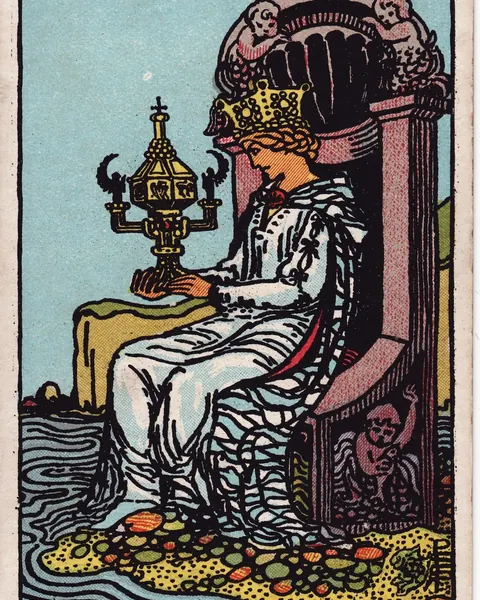
In the Rider–Waite–Smith deck, a queen sits on a stone throne right at the water's edge. Her throne is carved with water nymphs and a scallop shell, and colourful pebbles lie at her feet where the waves wash in. She holds an elaborate golden cup with two handles and a lid, decorated with angels or winged figures. She gazes at it intently, absorbed in contemplation.
Her cup is the only closed cup among the Cups court. What it holds is hidden, perhaps intuitions, dreams or feelings too deep for words. The Queen does not need to open it to know what is inside. She sees with the heart, and her stillness is a kind of listening.
- The covered cup: the mystery of the unconscious and intuitive knowledge. Feelings kept sacred and protected.
- The throne at the water's edge: she lives between land and sea, between the practical world and the emotional depths.
- Water nymphs and the shell: imagination, beauty and the creative power of Water.
- The pebbles at her feet: the ocean slowly shaping solid things. Emotions influencing everyday reality.
- Her absorbed gaze: deep focus and empathy. She gives her full attention to what she feels and to what others feel.
Upright
Upright, the Queen of Cups represents emotional maturity, compassion and intuition. She can sense what others feel and respond with kindness. When she appears, the card may ask you to lead with empathy, trust your intuition or offer care to yourself or someone who needs it.
Her Golden Dawn correspondence is Water of Water, ruling Gemini 20° to Cancer 20°. As the purest expression of the Water element, she is emotional depth itself: receptive, reflective and deeply feeling. The Cancer connection adds a nurturing, protective quality.
The Queen is not overwhelmed by her feelings. She can sit with strong emotions, her own and others', without being swept away. That steadiness is what makes her such a healing presence. She offers a safe space where people feel heard.
She is also connected to creativity and intuition. Artists, healers and counsellors often embody her energy. If you have been ignoring an inner sense about a situation, she encourages you to listen to it calmly.
As a person, the Queen of Cups describes someone warm, gentle, intuitive and empathetic, regardless of gender. Friends come to her for comfort and advice. She may be a counsellor, a caregiver, an artist or simply the friend who always knows what to say.
Reversed
Reversed, the Queen of Cups can describe emotional overload. You may be absorbing everyone else's feelings until you are exhausted, or swinging between moods without a sense of stability. Empathy without boundaries can be draining.
Self-sacrifice is another theme. The reversed Queen may give and give until there is nothing left for herself. If you feel resentful, tired or unseen, the card asks you to refill your own cup and set gentle limits.
It can also indicate oversensitivity or taking things personally, being so tuned in to emotional undercurrents that small comments feel like wounds. Grounding practices, honest conversations and time alone can help.
In some readings, the reversed Queen points to emotional dependence or manipulation through guilt. More often, though, it is a reminder that caring for others is sustainable only when you care for yourself too.
A helpful image for the reversed Queen is her closed cup knocked open, its contents spilling into everyone else's business. Putting the lid back on does not mean shutting people out. It means deciding what you can hold today, what belongs to someone else and when it is time to rest. A quiet evening, a walk by water or an honest "I can't take this on right now" can restore her balance.
Love
In love readings, the Queen of Cups is a warm, nurturing presence. She suggests emotional depth, understanding and a relationship where both people feel safe to be vulnerable.
| Situation | Upright | Reversed |
|---|---|---|
| Single | You attract people with your warmth and empathy. A caring, sensitive partner may appear, or you may be ready to love from a place of emotional maturity. | You may be giving too much too soon, or attracting people who need rescuing. Protect your heart and look for reciprocity. |
| In a relationship | Deep emotional connection and mutual care. A time to listen, nurture and grow closer. | One partner may feel emotionally drained or unheard. Balance giving and receiving, and express needs openly. |
| Reconciliation & breakups | Empathy and understanding may open the door to healing. You can approach the past with compassion. | Be careful of losing yourself in someone else's needs. Consider whether reconnecting supports your wellbeing. |
Money
Financially, the Queen of Cups is not focused on accumulation but on wellbeing. She suggests making decisions that support emotional security and caring for others in sensible ways, such as helping family or supporting a cause you believe in.
Her intuition can guide you, but it works best when combined with facts. Reversed, she warns against emotional spending, lending money out of guilt or neglecting your own finances while caring for others.
If you work in a caring or creative field, the Queen suggests valuing your contribution fairly. Compassion and fair payment can go together. This is general reflection, not financial advice.
Career & study
At work, the Queen of Cups favours caregiving, counselling, healthcare, teaching, the arts and any role where emotional intelligence matters. She suggests leading through empathy and creating a supportive environment for colleagues or clients.
If you are considering a career move, she encourages you to choose work that aligns with your values and emotional wellbeing. Reversed, she warns about burnout from emotional labour. Make sure you have boundaries and support.
For students, she favours subjects such as psychology, art, literature and the helping professions. She also suggests that studying in a calm, supportive environment helps you learn best. Reversed, emotional stress may affect concentration; self-care is part of studying well.
In any workplace, the Queen's quiet gift is noticing what others miss: the colleague who is struggling, the client who has not said what they really need, the tension in a meeting before it erupts. Trusting those perceptions, and voicing them tactfully, can make you invaluable. Just remember that you are allowed to clock off emotionally at the end of the day.
As your card of the day
When the Queen of Cups is your daily card, listen deeply, to others and to yourself. Offer kindness, trust your intuition and give yourself time to feel. Your calm presence can help someone today.
- Try: really listening to a friend without trying to fix their problem.
- Watch out for: taking on other people's emotions as if they were your own.
- One-line advice: Be a calm harbour, and remember you deserve shelter too.
Card combinations
- Queen of Cups + The High Priestess: deep intuition and inner wisdom. Trust what you sense.
- Queen of Cups + The Empress: nurturing, creativity and abundance. A powerful card pairing for care and fertility.
- Queen of Cups + King of Cups: emotional maturity in partnership. A caring, balanced couple.
- Queen of Cups + Queen of Swords: heart and mind in balance. Compassion combined with honest clarity.
- Queen of Cups + Four of Swords: rest and emotional recovery are needed before caring for others again.
The Queen within the suit of Cups
Queens in the tarot court represent the inner mastery of their element. They embody the suit's energy in a receptive, nurturing and mature way. The Queen of Cups is mastery of feeling: she knows emotion from the inside.
Among the Cups courts, the Page receives feelings with wonder, the Knight pursues them, the Queen holds them with empathy and the King governs them with calm wisdom. The Queen is the stage where emotional depth becomes a source of healing for others.
Compared with the other Queens, the Queen of Wands is warm and confident, the Queen of Swords is clear and honest and the Queen of Pentacles is practical and nurturing. The Queen of Cups is the most intuitive and empathetic, showing that sensitivity is a form of wisdom.