 smith
Imagery & symbolism (Rider–Waite–Smith)
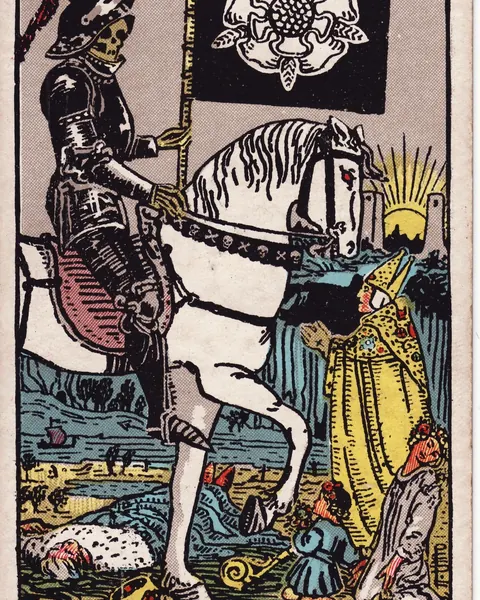
The Rider–Waite–Smith Death card shows a skeleton in black armor riding a white horse. He carries a black flag bearing a white five-petaled rose. Before him lie a fallen king, while a bishop or priest stands with hands joined, a young woman turns away, and a small child looks up at the rider without fear. In the background a river flows toward the horizon, a boat drifts along it, and the sun rises between two towers.
It is easily the most misunderstood card in the deck. Despite the skeleton, it almost never predicts physical death in a reading. Instead it speaks of transformation, the ending of one chapter so that another can begin. Notice that the rider moves slowly, not violently. And notice that sunrise in the distance: the scene is not the end of the world, but the end of a night.
- The skeleton in armor: what remains when everything temporary is stripped away. Death is universal and cannot be defeated, only accepted.
- The white horse: purity and the natural force of change, moving forward at a steady pace.
- The black flag with the white rose: the five-petaled rose is a symbol of beauty, life and renewal, even in the presence of endings.
- The fallen king: no status or power can resist the cycle of change.
- The bishop, the woman and the child: different responses to transformation, acceptance, avoidance and innocent openness.
- The river and the boat: the flow of life and the passage from one state to another, echoing ancient images of crossing to a new world.
- The rising sun between two towers: rebirth and the promise that light follows darkness; the same towers appear again in the Moon card.
Upright meaning
Upright, Death signals that something is ending, and that this ending is necessary. It may be a job, a relationship, a habit, a belief or a stage of life. The card does not say this is easy, but it does say it is natural. Just as seasons change, chapters close so that new ones can open.
The heart of the card is transformation. Death clears away what is outworn so that growth can happen. If you have been clinging to something that no longer fits, the card encourages you to let it go with grace. What you release creates space for something more aligned with who you are becoming.
Death is also a card of transition. It may describe a period of in-between, where the old has gone but the new has not fully arrived. This can feel uncomfortable, but it is a fertile space. Trust that the sunrise is coming, even if you cannot yet see it clearly.
The Golden Dawn connected Death with Scorpio, a sign of depth, intensity and regeneration. Like the scorpion and the phoenix often linked to that sign, the card speaks of deep, sometimes intense change that ultimately renews.
In practical readings, Death often appears around moves, career changes, breakups, graduations, and other major life transitions. Its advice is to face the change honestly rather than resist it.
Reversed meaning
Reversed, Death usually indicates resistance to change. You may know that something has ended but refuse to accept it, or you may be holding on out of fear of the unknown. The result is often stagnation, a sense of being stuck in a situation that has already lost its life.
The reversed card can also show a slow or delayed transition, where change is happening but gradually, with many setbacks. Patience and gentle effort can help you move through it. Sometimes the transformation is internal, and the outer world will catch up later.
Another reading is fear of endings themselves: avoiding closure, keeping doors open that should be shut, or repeating old patterns because they feel safe. The reversed Death card asks: what would happen if you let this go? Often the answer is relief.
Love
In love, Death signals transformation. For couples, this may mean the end of one phase of the relationship and the beginning of a deeper one, such as moving past the honeymoon stage or changing how you relate to each other. In some cases, it may indicate a relationship has run its course and needs to end.
As feelings, Death can mean the person feels that something between you must change, or that they are going through a deep internal shift.
| Situation | Upright | Reversed |
|---|---|---|
| Single | Letting go of an old love or old patterns clears space for someone new. A fresh chapter is beginning. | Clinging to the past or a former partner keeps you from moving forward. Allow closure. |
| In a relationship | The relationship is transforming. Embrace the change and grow together into a new phase. | Resisting necessary change, or staying in a relationship that has lost its life. Honest reflection is needed. |
| Reconciliation & breakups | A true ending may be necessary for both people to grow. If reconnection happens, it will be as different people. | Holding on to a relationship that has ended. Acceptance will bring peace. |
Money & finances
Financially, Death can signal the end of a financial chapter, such as a job ending, a debt being cleared, or a shift in how you manage money. It encourages you to release old habits that no longer serve you and adopt new ones.
Reversed, it may indicate clinging to financial patterns that are not working, or delaying necessary changes such as cutting expenses or changing income sources. For significant decisions, use real data and qualified advice rather than a card.
A Death-style money practice is to end one unhelpful habit completely, such as an unused subscription or impulse buying, and redirect that energy to something new.
Endings in money matters are often uncomfortable, but they are also the moment when a cleaner, simpler system becomes possible. Closing an old account or finishing a long repayment can feel like a small funeral and a small birthday at the same time.
Career & study
In career, Death often appears during major transitions: leaving a job, changing fields, restructuring, or reinventing yourself professionally. It suggests that an old role is ending and a new path is emerging.
For students, it may signal graduation, changing majors, or ending one phase of learning to begin another. Embrace the shift rather than clinging to the familiar.
Reversed, it may show staying in a job you have outgrown or resisting changes at work. Consider whether it is time to move on.
The card also supports professional reinvention. Skills from the role you are leaving rarely disappear; they are composted into the next one, often in ways you cannot predict yet.
As your card of the day / advice card
As your card of the day, Death invites you to let something go, perhaps a habit, a grudge or a piece of clutter. As an advice card, it says: release what is finished, and make room for what is coming.
- Good to do: declutter, close an old chapter, end an unhelpful habit, reflect on what is ready to change.
- Watch out for: clinging to the past, avoiding necessary endings, or fearing change.
- One-line advice: every ending is also a beginning, so let the sunrise come.
Card combinations
- Death + The Tower: sudden, dramatic transformation. Something falls away quickly, making room for profound change.
- Death + The Hanged Man: surrender leads to transformation. Letting go allows the transition to happen.
- Death + Temperance: transformation followed by healing and balance. A gentle new beginning after an ending.
- Death + The Fool: one chapter ends and a brand-new adventure begins. A clean slate.
Place in the Fool's Journey
In the Fool's Journey, Death follows the Hanged Man. Having learned to surrender and see things differently, the Fool now experiences a profound ending. Parts of his old self must die so that he can be reborn. This is one of the most important turning points of the journey.
After Death comes Temperance, the card of healing and integration. The Fool learns that endings are followed by a new balance. Drawing Death means you are in a season of transformation, and while it may be difficult, it is leading you toward renewal.
It is no accident that Death sits at number thirteen, just past the midpoint of the Major Arcana. The first half of the journey built a self; this card begins the work of refining it. The ego that the Emperor and Chariot strengthened must now loosen its grip, so that something more honest and more alive can take its place.