 smith
Imagery & symbolism (Rider–Waite–Smith)
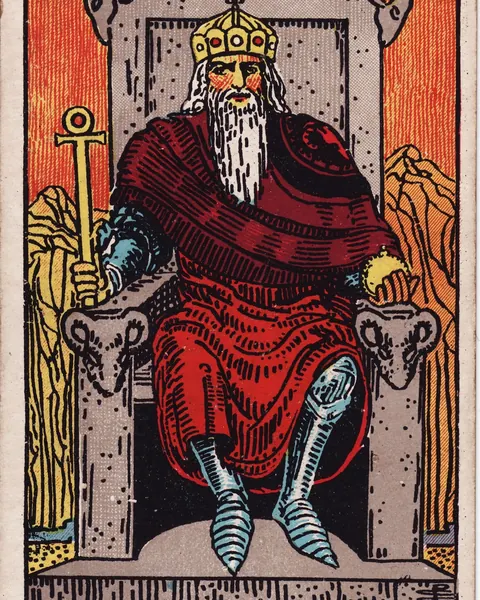
The Rider–Waite–Smith Emperor sits on a massive grey stone throne decorated with four ram heads, the symbol of Aries. He has a long white beard, wears a red robe over a suit of armor, and holds an ankh-shaped scepter in his right hand and a golden orb in his left. Behind him stretch bare, orange-red mountains with a thin stream at their foot.
The contrast with the Empress could hardly be stronger. She reclines in a lush garden; he sits upright in rocky terrain. Where she represents growth, he represents the framework that protects growth. The landscape looks harsh, but it is also solid. Nothing here will wash away in the next storm.
- The stone throne: permanence and reliability. Built to last rather than to be comfortable.
- The ram heads: Aries, the first sign of the zodiac, symbol of initiative, courage and leadership.
- The armor under the robe: readiness to defend what he has built. Authority backed by protection.
- The ankh scepter: an Egyptian symbol of life, showing that his power is meant to sustain life, not crush it.
- The golden orb: dominion over the world he governs, responsibility for the whole.
- The barren mountains: discipline, endurance, the difficult terrain where structure matters most. A thin river suggests emotion is present but kept in check.
- The number four: four corners, four walls, a square foundation. Stability in its most basic form.
Upright meaning
Upright, the Emperor tells you that order is your ally. Plans, schedules, rules and boundaries are not obstacles here; they are the scaffolding that will hold your goals up. If things have been chaotic, the card encourages you to bring structure: set priorities, define roles, make decisions and stick to them.
The Emperor is also a card of leadership and responsibility. Someone needs to take charge, and it may be you. Leading well, in this card's sense, means making decisions others can rely on, protecting the people who depend on you, and keeping your word. Respect is earned through consistency.
The card can describe an authority figure, such as a boss, father, official or institution, or the authority inside you that sets limits and follows through. In practical matters it often favors legal, administrative or organizational solutions: contracts, procedures, systems.
Emotionally, the Emperor asks for steadiness. It does not mean shutting feelings out, but not letting them make every decision. Calm, clear thinking under pressure is his particular strength. When others panic, the Emperor asks what the next sensible step is, takes it, and then takes the one after that. That kind of steadiness is contagious, and it is often what a team, a family or your own anxious mind needs most.
Reversed meaning
Reversed, the Emperor's structure becomes either too rigid or too weak. On the rigid side, it shows control that has gone too far: micromanagement, stubbornness, “my way or no way” attitudes, or an authority figure who uses power to dominate rather than protect. If you are dealing with such a person, the card advises firm boundaries; if you recognize the pattern in yourself, it invites more flexibility.
On the weak side, the reversed Emperor points to missing discipline: plans with no follow-through, chaos at home or work, nobody taking responsibility. You may be avoiding a leadership role you need to step into, or waiting for someone else to set the rules.
In either case, the fix is balance. Structure should serve people and goals. Ask whether your current rules are actually helping, and adjust them rather than abandoning order altogether.
Love
In love, the Emperor stands for commitment, reliability and protection. It suits relationships that are stable, clearly defined and built on mutual respect. It can also describe a partner who is dependable, perhaps a little traditional, who shows love through actions more than words.
As feelings, the Emperor suggests serious intentions and a protective attitude, though emotions may be expressed in a reserved way.
| Situation | Upright | Reversed |
|---|---|---|
| Single | You are drawn to someone mature and dependable. Be clear about what you want and the right kind of person will respect it. | A controlling or emotionally unavailable partner. Keep your standards and do not mistake control for care. |
| In a relationship | Stability and commitment. A good time to make plans, define the relationship, or build a shared future. | Power struggles or one person making all the decisions. Share responsibility and soften the rules. |
| Reconciliation & breakups | Reconnection is possible if both sides set clear terms and take responsibility for what went wrong. | Rigid positions or old patterns of control. Without real change, the same issues may return. |
Money & finances
With money, the Emperor favors planning, budgeting and long-term strategy. It is a good card for setting up savings systems, getting paperwork in order, or building something solid rather than chasing quick wins. Discipline now creates security later.
Reversed, watch for poor organization, careless spending, or a financial situation controlled too tightly by someone else. Get clarity on who decides what. For substantial financial choices, consult real data and qualified advice rather than relying on a card.
An Emperor-style habit is to give your money a structure: fixed dates for paying bills, clear limits for categories, and a regular review. Even a simple monthly check of income, fixed costs and savings goals gives you the calm overview he values, and makes it far easier to say no to purchases that do not fit the plan.
Career & study
In career, the Emperor favors leadership roles, management, government, law, finance, engineering and any field built on systems and rules. It can point to a promotion, increased responsibility or a mentor with authority. It also encourages you to act like a leader before the title arrives.
For students, the Emperor means discipline: a study schedule, consistent routines, and treating learning like a project to manage. Structure will beat motivation on the days motivation runs out.
Reversed, it may show friction with a rigid boss, bureaucracy that slows everything down, or your own reluctance to take charge. Pick the boundaries worth defending and let the rest go.
As your card of the day / advice card
As a card of the day, the Emperor suggests putting one area of life in order. Make a plan, clear the desk, finish the paperwork, set a boundary you have been avoiding. As an advice card it says: take responsibility, decide clearly, and follow through.
- Good to do: make a schedule, organize your finances, lead a meeting, keep a promise, set clear boundaries.
- Watch out for: stubbornness, controlling others, or being so rigid that you miss a better option.
- One-line advice: structure is a form of care, so build something sturdy enough to hold your goals.
Card combinations
- The Emperor + The Empress: structure and nurture together. A powerful partnership, a stable family, or a business with both heart and strategy.
- The Emperor + The Hierophant: established institutions and traditions. Official processes, formal education, or rules you are expected to follow.
- The Emperor + Justice: legal matters, contracts and fair decisions. Order backed by principles.
- The Emperor + The Chariot: disciplined drive toward a goal. Leadership that moves forward with determination and control.
Place in the Fool's Journey
In the Fool's Journey, the Emperor follows the Empress. The Fool has discovered abundance and nurture; now he learns about order, rules and responsibility. The Emperor is often seen as the father figure of the Major Arcana, the one who teaches that freedom needs a framework to survive.
After him comes the Hierophant, who adds tradition and shared values to the Emperor's laws. Drawing the Emperor means it is time to build foundations, so that whatever grows next has somewhere solid to stand.
It is worth remembering that the Emperor is only the fourth step of the journey. His authority is real but not final; later cards such as Strength, Justice and Temperance will refine it with compassion, fairness and balance. The lesson he leaves behind is not domination but dependability, the ability to create a safe framework where you and the people around you can grow.