 smith
Imagery & symbolism (Rider–Waite–Smith)
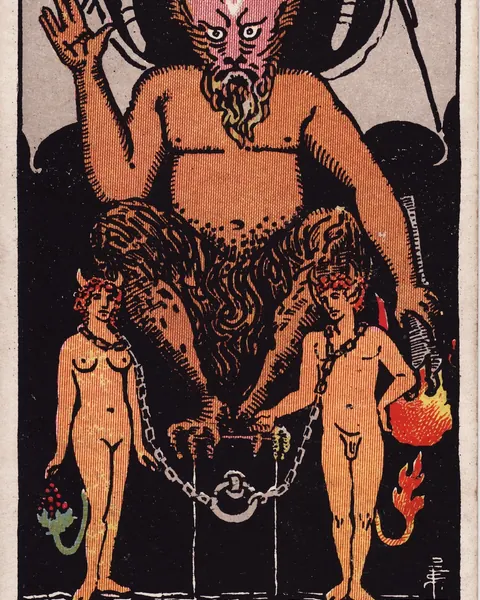
The Rider–Waite–Smith Devil is a horned, bat-winged creature with the legs and feet of a goat, crouched on a black half-cube pedestal. An inverted pentagram glows on his forehead, his right hand is raised with fingers spread, and his left hand holds a lit torch pointed downward. Chained to the pedestal stand a naked man and woman with small horns and tails; the woman's tail ends in a bunch of grapes and the man's in a flame. The background is pure black.
The scene deliberately mirrors the Lovers. The same pair of humans who stood openly beneath an angel now stand bound beneath a dark figure. What changed? Look closely: the chains around their necks are loose enough to lift off. Nothing physical prevents them from walking away. The Devil's power is the power of attachment, fear and habit, a prison that is partly self-made.
- The horned figure: modeled on Baphomet and the goat-god imagery of medieval art, a symbol of instinct, material desire and our shadow side.
- The inverted pentagram: spirit placed beneath matter, priorities turned upside down.
- The loose chains: attachments that feel binding but can be removed. Freedom is closer than it seems.
- The tails of grapes and flame: indulgence and passion, the ordinary pleasures of life that become traps in excess.
- The downward torch: energy and desire directed toward the material and instinctive rather than the higher self.
- The black half-cube: a limited, incomplete foundation, the narrow world of only what can be owned or consumed.
- The number fifteen: one plus five makes six, linking the Devil directly to the Lovers as its shadow.
Upright meaning
Upright, the Devil shows where you may be stuck. It often points to unhealthy attachments, such as habits, relationships, substances, spending, work or ways of thinking that you know are not good for you but feel hard to leave. The card does not shame you for this; it simply names it, which is the first step toward change.
A central theme is temptation and indulgence. The Devil is the card of “just one more”: one more purchase, one more drink, one more scroll, one more night with someone who does not treat you well. These pleasures are not evil in themselves, but they can take control when used to fill an emptiness or avoid discomfort.
The Devil also represents the shadow self, the parts of us we prefer not to look at, such as envy, greed, fear, or desires we judge harshly. Facing them honestly, without denial or self-condemnation, can be surprisingly freeing. What we acknowledge loses some of its hidden grip.
Its Golden Dawn sign, Capricorn, adds a material angle. The card can point to an excessive focus on money, status, ambition or control, the feeling that you cannot rest until you have more. It asks whether your goals are serving you or whether you are serving them.
Not every Devil reading is heavy. Sometimes it is about playful sensuality, strong physical attraction or simply enjoying earthly pleasures. The key question is always whether you are choosing freely or acting on compulsion.
Reversed meaning
Reversed, the Devil is often a hopeful card. It can show release: lifting the chain off, breaking a bad habit, leaving a toxic situation or seeing clearly what has been holding you back. You are reclaiming your own power.
The reversed card can also indicate the process of facing your shadow, when you become aware of patterns and begin to change them. This can be uncomfortable, but awareness is the key that unlocks the chain.
In some readings, the reversed Devil warns that you may be close to freedom but tempted to slip back into old patterns. Stay mindful, seek support where you need it, and celebrate each small step toward independence. If a pattern involves addiction or harm, reaching out to qualified professionals or support services is a sign of strength.
Love
In love, the Devil often points to intense attraction, passion and sensuality, but also possible obsession, jealousy, possessiveness or codependency. It can describe a relationship that feels hard to leave even when it is not healthy, or a connection based more on physical chemistry than deeper compatibility.
As feelings, the Devil suggests strong desire and attraction, possibly mixed with possessiveness. The person may feel drawn to you in a way they find hard to control.
| Situation | Upright | Reversed |
|---|---|---|
| Single | Intense attraction or a magnetic but complicated connection. Enjoy the chemistry, but keep your eyes open. | Freeing yourself from a past attachment or unhealthy dating patterns. You are ready for something healthier. |
| In a relationship | Passion is strong, but check for jealousy, control or codependency. Healthy love leaves room to breathe. | Breaking unhealthy patterns together, or one partner finding the courage to set boundaries. |
| Reconciliation & breakups | Returning may be driven by attachment or habit rather than genuine compatibility. Reflect honestly. | Letting go of a relationship that kept you bound. Freedom and self-respect come first. |
Money & finances
Financially, the Devil warns about materialism, debt, impulsive spending or being trapped by financial obligations. It can show a job you stay in only for the money, or spending that serves emotions more than needs.
Reversed, it suggests breaking free, such as paying off debt, changing spending habits or reducing dependence on things that drain you. For significant financial decisions or debt problems, rely on real information and qualified advice rather than a card.
A Devil-style exercise is to notice which purchases feel compulsive and which feel truly chosen. That awareness alone often loosens the chain.
The card can also prompt a gentle question about status. If part of your spending is driven by how things look to others, imagine your life without an audience and ask which expenses would remain. The answer can be a powerful guide.
Career & study
In career, the Devil can indicate feeling trapped in a job, workaholism, toxic workplace dynamics or ambition that comes at a high personal cost. It may also point to golden handcuffs, where good pay keeps you somewhere you do not want to be.
For students, it can show procrastination, distraction or pressure to succeed at all costs. Notice which habits are sabotaging your progress.
Reversed, it suggests freeing yourself from limiting work situations, setting boundaries with demanding employers or rediscovering what you actually want from your career.
On a more positive note, Capricorn's drive is also here. Used consciously, the Devil's hunger can become healthy ambition, the willingness to work hard for something you truly value rather than something you feel you must have.
As your card of the day / advice card
As your card of the day, the Devil invites you to notice one habit or attachment that controls you more than you would like. You do not need to fix everything today; just see it clearly. As an advice card, it says: you hold more power than you think, so the chain can come off.
- Good to do: identify a habit you want to change, set a boundary, reflect on what truly makes you happy, enjoy pleasures mindfully.
- Watch out for: compulsive spending, unhealthy relationships, overindulgence, or giving away your power.
- One-line advice: look at the chain closely; it may be looser than you think.
Card combinations
- The Devil + The Lovers: intense attraction that may be binding or obsessive. Check whether the connection is free or controlling.
- The Devil + The Tower: a dramatic break from a trap. Chains are shattered, sometimes suddenly.
- The Devil + Temperance: moderation is needed to overcome excess or addiction. Balance breaks the spell.
- The Devil + The Hierophant: rigid beliefs or institutions that restrict freedom. Question the rules that bind you.
Place in the Fool's Journey
In the Fool's Journey, the Devil follows Temperance. Having found balance, the Fool must now confront his shadow side, the desires, fears and attachments that still hold him. This is a test of whether his newfound harmony can withstand temptation.
Seeing the chains clearly is the first step to freedom. After the Devil comes the Tower, where false structures collapse and he is released, sometimes abruptly. Drawing the Devil means you are being invited to look honestly at what binds you, so that you can begin to break free.