 smith
Imagery & symbolism (Rider–Waite–Smith)
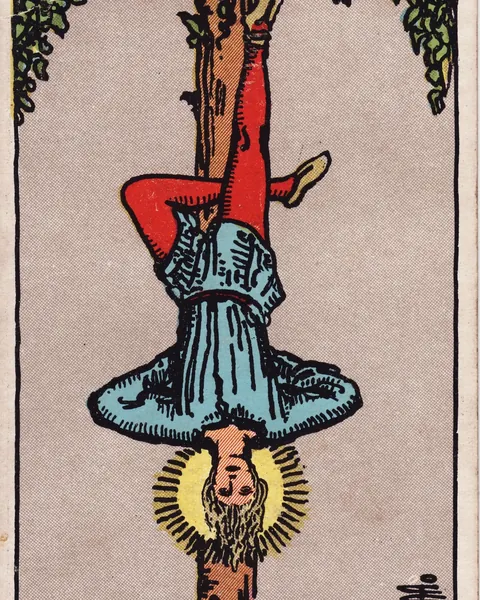
The Rider–Waite–Smith Hanged Man hangs upside down from a living T-shaped tree, tied by his right foot. His left leg is bent behind the right knee, forming a figure like an inverted 4, and his arms are folded behind his back. He wears a blue tunic and red tights, and a bright golden halo shines around his head. His face is calm, even peaceful. There is no sign of pain or struggle.
The serenity is what makes the card so intriguing. This is not punishment; it is voluntary suspension. He has chosen to stop, to hang between earth and sky, and in doing so he has gained a vision that is literally upside down from everyone else's. The halo suggests that insight, perhaps even enlightenment, comes from this willingness to pause and surrender.
- Hanging upside down: a reversal of perspective. What looked important may look trivial, and what seemed small may now seem vital.
- The living tree: the T-shape, sometimes called a tau cross, is made of living wood with leaves, suggesting that this pause is part of growth, not death.
- The halo: illumination, insight and spiritual awakening gained through surrender.
- The crossed leg forming a 4: a reference to the Emperor's number, structure turned on its head, or the stable world seen from a new angle.
- Arms behind his back: willing surrender. He is not trying to escape or control anything.
- Red and blue clothing: passion and calm, body and spirit held in balance while suspended.
- The number twelve: the twelve signs of the zodiac or months of the year, a full cycle seen from a new vantage point.
Upright meaning
Upright, the Hanged Man asks you to pause. Things may feel stuck, delayed or in limbo, and rather than fighting it, the card suggests accepting the stillness. This is not wasted time. It is a period for reflection, incubation and seeing your situation from a completely new angle.
A key theme is surrender. You may need to let go of control, release a fixed idea of how things should go, or stop forcing a result. Often the answer arrives precisely when you stop chasing it. The Hanged Man invites you to trust the process and allow insight to emerge.
The card can also point to sacrifice, giving up something in the short term for a greater long-term benefit. This might mean postponing a plan, accepting a temporary setback or letting someone else take the lead. Done consciously, such sacrifices can be deeply rewarding.
The Golden Dawn associated this card with the element of Water, and modern readers link it to Neptune, both suggesting fluidity, intuition and dissolving rigid boundaries. Emotionally, the Hanged Man encourages you to feel and absorb rather than act immediately.
Practically, the card often suggests waiting before making a big decision. More information or a shift in perspective is coming.
Reversed meaning
Reversed, the Hanged Man can show stalling without purpose: waiting for the sake of waiting, procrastinating or feeling stuck and frustrated. You may know a change is needed but keep putting it off. The card gently suggests that the pause has lasted long enough.
The reversed card can also indicate resistance to letting go. You might be holding tightly to a situation, a belief or a relationship that no longer serves you, and fighting the natural process of surrender. Struggling against the rope only makes it tighter.
Another reading is needless martyrdom: sacrificing yourself repeatedly without real benefit, or playing the victim to avoid taking action. Ask whether your sacrifices are meaningful or simply habitual. Sometimes the healthiest step is to stop hanging and come down.
Love
In love, the Hanged Man often signals a pause or a waiting period. A relationship may be in limbo, a decision may need more time, or you may need to see your partner or situation from a new perspective. Patience and openness are key.
As feelings, the Hanged Man suggests the person may feel uncertain or stuck, unsure how to move forward. They may need time to process.
| Situation | Upright | Reversed |
|---|---|---|
| Single | Use this pause to reflect on what you really want in love. Clarity will come if you do not rush. | Waiting for someone who is not available, or stuck in the same patterns. Consider letting go. |
| In a relationship | A period of stillness or change in perspective. Try seeing things from your partner's point of view. | Stagnation or one partner sacrificing too much. Address imbalances rather than waiting them out. |
| Reconciliation & breakups | Time apart may bring new understanding. Do not force a decision; let insight emerge. | Holding on to hope without action. It may be time to accept and move forward. |
Money & finances
Financially, the Hanged Man suggests holding off on major decisions. It is a good time to review your situation from a fresh angle, reconsider priorities and wait for more clarity before acting.
Reversed, it may indicate financial stagnation or delaying necessary action, such as avoiding a budget review or a difficult conversation. Take small steps forward. For significant decisions, rely on real information and qualified advice rather than a card.
The Hanged Man also invites you to question assumptions. Do you need what you think you need? Sometimes a change in perspective frees resources you did not know you had.
A sensible Hanged Man move is a short spending pause: a week or a month where you postpone non-essential purchases and simply notice what you miss. The answer is often surprising, and it gives you a clearer picture of what really matters before you commit to anything bigger.
Career & study
In career, the Hanged Man can indicate a pause, such as a delayed promotion, a project on hold or a period of waiting for an answer. Use this time to reflect, learn and reconsider your direction rather than pushing against the delay.
For students, it may suggest taking a step back to approach a subject from a new angle, or pausing to reconsider your study path. A break can bring fresh insight.
Reversed, it may indicate feeling stuck in a job, procrastinating on career decisions or sacrificing too much for work. It may be time to take action.
The Hanged Man can also favor creative and unconventional thinking. Problems that resist every normal solution sometimes give way when you literally turn them upside down: start from the end result, ask what the opposite approach would look like, or invite a beginner's view.
As your card of the day / advice card
As your card of the day, the Hanged Man invites you to slow down and see something from a different perspective. If you feel stuck, try a new approach rather than pushing harder. As an advice card, it says: let go of control and allow the answer to come to you.
- Good to do: take a break, meditate, reconsider a problem from a new angle, practise patience.
- Watch out for: forcing results, procrastinating, or making sacrifices that do not serve you.
- One-line advice: when you cannot move forward, try turning the picture upside down.
Card combinations
- The Hanged Man + The Hermit: deep reflection and spiritual insight. A period of solitude brings clarity.
- The Hanged Man + Death: letting go leads to transformation. Surrender prepares the way for an ending and a new beginning.
- The Hanged Man + The Star: hope after waiting. Patience brings healing and renewal.
- The Hanged Man + Justice: a decision delayed until the facts are clear. Fairness comes through patience.
Place in the Fool's Journey
In the Fool's Journey, the Hanged Man follows Justice. Having learned responsibility and the law of cause and effect, the Fool now meets a new kind of wisdom, the wisdom of surrender. He discovers that not everything can be solved by action; some insights come only through stillness and letting go.
This lesson prepares him for Death, where he will face profound endings and transformation. Drawing the Hanged Man means you are in a liminal space, between what was and what will be, and this pause is an essential part of your journey.
Many traditions tell similar stories. In Norse myth, Odin hung for nine nights on the world tree to gain the wisdom of the runes, and readers often mention that image alongside this card. Whatever the source, the pattern is the same: a voluntary pause, an uncomfortable in-between, and then a new kind of knowing. The Hanged Man promises that your waiting, if you use it well, will not be empty.