 smith
Imagery & symbolism (Rider–Waite–Smith)
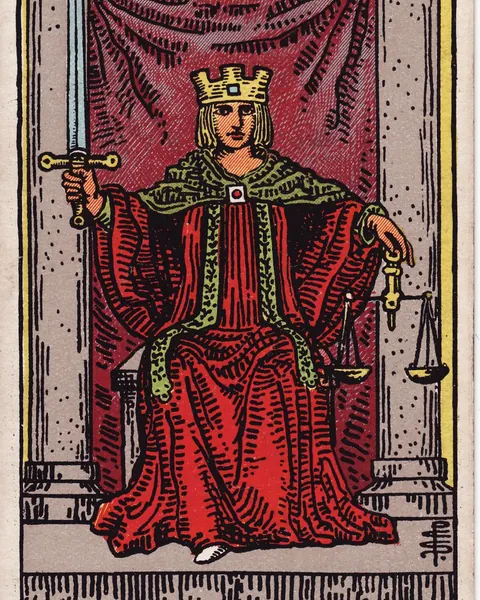
In the Rider–Waite–Smith deck, Justice is a crowned figure in a red robe seated on a stone throne between two grey pillars. In her right hand she holds an upright double-edged sword; in her left, a pair of golden scales. A purple veil hangs behind her, and one white shoe peeks out from beneath her robe. Unlike many classical statues of Justice, she is not blindfolded. She looks straight ahead, eyes open.
That open gaze is the heart of the card. Tarot Justice does not judge blindly; she sees the facts clearly and weighs them. Her sword cuts through confusion to the truth, and her scales measure what is fair. The pillars and veil echo the High Priestess and Hierophant, but here the hidden is brought into the light and examined.
- The upright sword: clarity, truth and decisive action. Its two edges remind us that every decision cuts both ways.
- The golden scales: balance, fairness and the careful weighing of evidence and consequences.
- Her open eyes: conscious, impartial judgment based on what is really there, not on prejudice or wishful thinking.
- The red robe: action and the practical world; justice is not only an ideal but something carried out.
- The pillars and veil: structure and the boundary between what is known and unknown, now examined openly.
- The white shoe: a small detail often read as the spiritual consequence of actions taken in the physical world.
- The number eleven: in Waite's order, Justice sits at 11 and Strength at 8, matching the Golden Dawn's astrological sequence with Libra.
Upright meaning
Upright, Justice is about truth and fairness. It suggests that a situation will be resolved according to the facts, and that honesty will be rewarded. If you have acted with integrity, this is reassuring. If not, the card is a reminder that consequences follow choices, sooner or later.
Justice is also a card of responsibility. It asks you to look honestly at your part in a situation, take ownership of your actions and make amends where needed. This is not about guilt; it is about clarity. When you accept responsibility, you regain the power to change things.
In practical terms, Justice often appears in connection with legal matters, contracts, agreements, official decisions and negotiations. It favors fair outcomes, transparent processes and well-documented positions. Keep records, read carefully and speak truthfully.
Libra, the sign linked to this card, is about balance and harmony in relationships. Justice therefore also points to fairness between people: equal effort, mutual respect and decisions that consider both sides.
Justice can also describe a decision you must make yourself. The card advises weighing the evidence calmly, considering long-term consequences and choosing what is right rather than what is merely comfortable.
Reversed meaning
Reversed, Justice warns of unfairness, imbalance or dishonesty. You may feel you are being treated unjustly, or that a decision is biased. The card encourages you to gather facts, seek proper advice and stand up for yourself calmly and clearly.
The reversed card can also be a mirror. It may point to avoiding responsibility, shading the truth or refusing to see your own role in a problem. Being honest with yourself, even when uncomfortable, is the first step toward restoring balance.
In legal or official matters, reversed Justice can indicate delays, complications or outcomes that do not feel fair. Check the details, keep records, and seek qualified professional help rather than relying on chance.
Love
In love, Justice emphasizes fairness, honesty and balance. A healthy relationship under this card is one where both partners give and take equally, communicate truthfully and respect each other's needs. It can also point to decisions about commitment, such as moving in, marrying or separating, made with a clear head.
As feelings, Justice suggests the person is weighing the relationship thoughtfully, perhaps cautiously, and values honesty above all.
| Situation | Upright | Reversed |
|---|---|---|
| Single | Look for a partner who shares your values and treats you as an equal. Clarity about your standards attracts the right person. | Past imbalances or unfair treatment may still affect you. Heal before entering a new relationship. |
| In a relationship | A balanced, honest partnership. A good time for important conversations and fair agreements. | One partner may feel unfairly treated, or there is dishonesty. Address imbalances openly. |
| Reconciliation & breakups | A fair, honest assessment of what went wrong is needed. Reconnection works only if both sides take responsibility. | Blame and resentment cloud the issue. Focus on truth rather than winning the argument. |
Money & finances
Financially, Justice favors honesty, balance and careful record-keeping. It is a good time to review contracts, settle debts, resolve disputes and make sure your finances are in order. Fair dealings bring stable results.
Reversed, it warns of unfair contracts, hidden fees or financial dishonesty. Read the small print and do not sign anything you do not understand. For significant money decisions or disputes, seek qualified advice rather than relying on a card.
A practical Justice habit is to keep financial agreements in writing, even with friends and family. Clarity protects relationships as well as money.
Justice also asks whether your financial life is in balance with your values. Paying people on time, splitting shared costs fairly and keeping promises about money are small acts that build a reputation for reliability, and that reputation tends to come back to you as trust and opportunity.
Career & study
In career, Justice favors law, government, mediation, administration, compliance, research and any role that requires impartiality and attention to detail. It can point to a fair performance review, a contract negotiation or a decision about your role that will be made on merit.
For students, Justice is excellent for exams that test precise knowledge, debate, law studies and any subject where careful analysis is valued. Study honestly, cite sources properly and prepare thoroughly.
Reversed, it may indicate unfair treatment at work, office politics or disputes over credit. Document your work and address issues through proper channels.
When you are the one making decisions, for example hiring, grading or allocating tasks, Justice asks you to apply the same standards to everyone, including people you like and people you do not.
As your card of the day / advice card
As your card of the day, Justice invites you to be honest and fair in all your dealings. Keep your word, tell the truth and consider how your actions affect others. As an advice card, it says: weigh things carefully and make the choice you can stand behind.
- Good to do: settle accounts, sign contracts after reading them, have honest conversations, make balanced decisions.
- Watch out for: shortcuts that bend the truth, impulsive judgments, or letting bias cloud your view.
- One-line advice: act today in a way you would be proud to explain tomorrow.
Card combinations
- Justice + The Emperor: legal and official matters, structured by rules and authority. A good pairing for contracts and formal decisions.
- Justice + Wheel of Fortune: karma and consequences. Past actions come back around, for better or worse.
- Justice + Judgement: a final reckoning. A decision based on careful evaluation and accountability.
- Justice + Temperance: balance and harmony. Fair compromise and calm resolution.
Place in the Fool's Journey
In the Fool's Journey, Justice follows the Wheel of Fortune. Having experienced the cycles of fate, the Fool now learns that he is not merely carried by the wheel; he is also responsible for his choices. Justice teaches him the law of cause and effect and the importance of acting with integrity.
This sense of responsibility prepares him for the Hanged Man, where he will be asked to let go and see things from a new perspective. Drawing Justice means it is time to be honest, take responsibility and make choices that reflect your truest values.
Placed near the center of the Major Arcana, Justice also acts as a kind of balance point for the whole sequence. The first half of the journey built up the Fool's will and identity; the second half will test them. Before that testing begins, Justice asks him to settle his accounts and see his life clearly.