 smith
Imagery & symbolism (Rider–Waite–Smith)
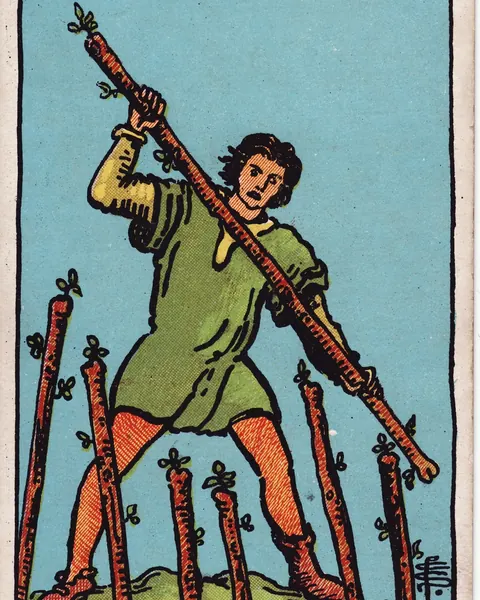
In the Rider–Waite–Smith Seven of Wands, a young man stands on the edge of a rise, holding a single wand across his body like a quarterstaff. Six other wands push up toward him from below, held by unseen opponents. His expression is determined, and he leans into the fight. A curious detail: he is wearing two different shoes, a boot on one foot and a low shoe on the other.
The scene is about holding a position. After the triumph of the Six of Wands, success has attracted challengers, and now the winner must defend what they gained. He is outnumbered, yet he has the higher ground, and that advantage of position is what keeps him in the fight.
- The single wand against six: one person standing up to many pressures, opinions or rivals. Courage here means not being swept along by the crowd.
- The high ground: your advantage. Experience, skill or a strong position helps you hold steady even when the odds look uneven.
- Opponents unseen below: challenges whose full shape you cannot see. Some of the pressure may be bigger in your mind than in reality.
- The mismatched shoes: he was caught off guard and had no time to prepare properly. You may be defending yourself on short notice, improvising as you go.
- The green landscape: there is still growth here. What you are defending is alive and worth protecting.
Upright
Upright, the Seven of Wands is the card of standing your ground. It appears when you have something worth protecting, such as a position, a belief, a boundary, a reputation or a project, and others are challenging it. The message is clear: do not give up simply because the pressure is strong. You are in a better position than it may seem.
The Golden Dawn named it the Lord of Valour and assigned it to Mars in the third decan of Leo. Mars brings fighting spirit and courage, and Leo adds pride and a strong sense of self. The combination is a fierce, dignified determination: the energy of someone who will not be pushed off their hill without a struggle.
This card also speaks of conviction. If you believe in what you are doing, the Seven asks you to stand by it even when it is unpopular. That might mean defending a creative choice, holding a boundary with family, keeping your price in a negotiation or continuing a project that others doubt. Your persistence is a statement in itself.
Yet valour is not the same as stubbornness. The upright Seven works best when you know exactly what you are defending and why. Pick the core of your position and protect that, rather than trying to win every small point. Being on the high ground lets you choose where to spend your energy.
Reversed
Reversed, the Seven of Wands can show exhaustion after a long defence. You may be tired of justifying yourself, tired of competition or simply worn out by constant pressure. It is not weakness to feel this way; even the strongest defender needs rest.
It can also describe giving in. Perhaps you are letting others' opinions override your own, dropping a boundary to avoid conflict or abandoning a plan because the criticism is loud. The reversed Seven asks whether you are stepping back from wisdom or from fear. One is strategy; the other can leave you regretting it.
The opposite pattern is equally possible: over-defensiveness. If you treat every comment as an attack, you will spend all your energy fighting battles that do not need to be fought. Some of those staves below may belong to people who are trying to help. Lowering your guard a little can reveal who is actually on your side.
Finally, it may point to missing the moment to retreat. Sometimes holding the hill is no longer worth the cost. A graceful withdrawal, saving your strength for a better fight, can be the bravest choice of all.
Love
In love, the Seven of Wands is about protecting a relationship or your own boundaries. It can describe defending your partnership against outside interference, facing competition for someone's affection or standing firm on what you need. It may also show a defensive attitude that makes intimacy harder.
| Situation | Upright | Reversed |
|---|---|---|
| Single | You may need to stand by your standards rather than settling for less. If there is competition for someone's attention, show who you are with confidence instead of fighting for approval. | Past hurts may have made you so guarded that no one can get close. Consider lowering your defences a little with people who have earned some trust. |
| In a relationship | You may be protecting the relationship from outside opinions, family pressure or other challenges. Standing together makes you stronger than either of you standing alone. | Constant defensiveness or small power struggles are draining you both. Ask whether you are fighting each other or fighting for the relationship. |
| Reconciliation & breakups | If you want to try again, you may have to stand by your choice despite doubts from friends or family. Be clear about why you believe it can work this time. | You may be holding on to a position, or a grudge, longer than is good for you. Letting go of the fight can be a relief, whatever happens next. |
Money
Financially, the Seven of Wands suggests protecting what you have built. It can mean defending your prices, negotiating firmly, guarding your savings against pressure to spend or holding your position in a competitive market. It is a card for knowing your worth and not discounting it simply because someone pushes back.
It can also describe financial pressure from several directions at once, such as multiple bills, competing demands or people asking you for help. Prioritise calmly. Decide what matters most and defend that first. Reversed, the card can show giving in to pressure, perhaps lending or spending money you had planned to keep, or the fatigue of always having to fight for fair payment.
In practical terms, clear agreements, written terms and a simple budget are your best shields. They let you hold your ground without needing to argue every time.
Career & study
At work, the Seven of Wands often appears when you are defending a position, an idea or a project. You may face criticism, competition from newer colleagues or rivals in your market. The card encourages you to stand by your expertise and to present your case firmly and clearly. You have earned your place, and you do not need to apologise for it.
It can also describe holding firm after a promotion, when people are testing your authority, or protecting your time from endless extra demands. Setting clear boundaries is part of good leadership.
For students, the card may point to defending a thesis, debating, sticking with a study plan when others around you are slacking or holding steady through a competitive selection process. Reversed, it can show burnout or self-doubt under pressure. Rest strategically, then return to the work with your priorities clearly set.
As your card of the day
When the Seven of Wands is your card of the day, expect to stand up for something. It could be a small boundary, an opinion in a meeting or simply your plan for the day when others try to pull you off course. Be firm but not hostile, and decide in advance which points really matter.
- Try: saying no to one request that does not fit your priorities, or calmly explaining your position on an issue you care about.
- Watch out for: treating every question as a challenge, or wearing yourself out on battles that are not important.
- One-line advice: Hold the high ground with courage, but choose your battles wisely.
Card combinations
- Seven of Wands + Strength: gentle but unbreakable determination that protects the situation without aggression.
- Seven of Wands + The Emperor: set clear rules and principles to defend your territory firmly.
- Seven of Wands + Nine of Wands: a long period of holding on continues. You are tired, but you are nearly there.
- Seven of Wands + The Hanged Man: instead of fighting, pause and look at the situation from another angle.
- Seven of Wands + Six of Wands: success invites challengers. Recognition is real, but you will need to keep proving it.
The number 7 in the suit of Wands
In tarot numerology, seven is the number of testing, reflection and inner strength. After the harmony of the six, the seven asks whether your achievement can withstand pressure. Each Seven presents a trial: the illusions of the Seven of Cups, the strategy and evasion of the Seven of Swords, the patient waiting of the Seven of Pentacles.
For Wands, the suit of will and action, the test takes the form of a challenge to your position. The victory of the Six is not the end of the story; now you have to show that you can keep what you won. That requires courage, but also clarity about what is truly worth defending.
Within the arc of the suit, the Seven connects triumph to endurance. It is followed by the swift movement of the Eight, then the weary persistence of the Nine and the heavy load of the Ten. The Seven teaches you how to hold steady under pressure, which is exactly the skill you will need later. It is a card about earning your place twice: once by winning it, and again by keeping it with integrity.