 smith
Imagery & symbolism (Rider–Waite–Smith)
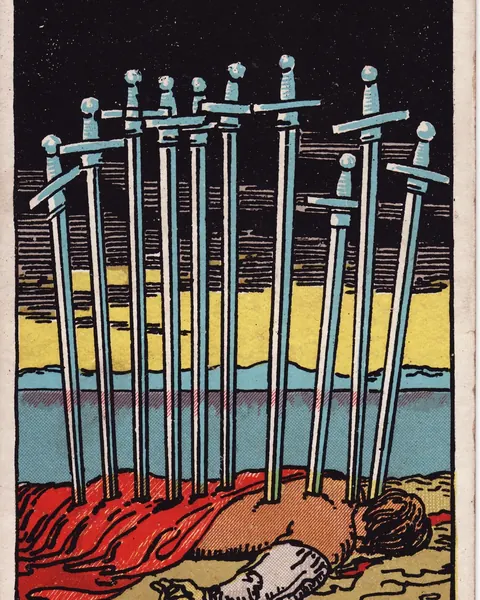
The Rider–Waite–Smith Ten of Swords is one of the most dramatic pictures in the deck. A figure lies face down by a still body of water, covered by a red cloth, with ten swords standing upright along their back. The upper sky is completely black. Yet along the bottom of the scene, behind distant hills, the sky is turning gold and the water is calm.
It is worth reading this card the way tarot readers have long read it: as theatre and symbol rather than a literal event. The sheer number of swords is deliberately excessive, almost exaggerated, as if to say that this ending is total and unmistakable. Something has run its full course. And the brightening horizon is just as much part of the message as the darkness above.
- Ten swords: a situation that has been taken as far as it can go. Nothing remains to be fought over.
- The figure lying still: complete surrender, the point where struggling stops.
- The black sky: the heaviest moment of a hard period, the darkest hour of the night.
- The golden dawn: the new day that always follows. It is already on its way.
- The calm water: emotions settling once the storm of thought has spent itself.
- The hand making a gentle gesture: in many readings, the right hand forms a sign of blessing, hinting that even this ending carries something sacred.
Upright
Upright, the Ten of Swords stands for an ending that is final and clear. A job, a relationship, a belief or a way of doing things has reached its conclusion, and there is no point in trying to revive it in its old form. It can feel like hitting bottom. The card's quiet comfort lies in that very fact: once you are at the bottom, every further step is an upward one.
Because this is a Swords card, the ending often concerns thought patterns as much as circumstances. Perhaps a way of explaining things to yourself has stopped working, or a worry you carried through the Eight and Nine of Swords has finally exhausted itself. Accepting that it is over can bring a surprising sense of release. There is nothing left to defend.
The advice of the Ten is to let the ending be an ending. Rest, grieve if you need to, and resist the urge to immediately rebuild the same structure. The dawn on the horizon is real, but it comes in its own time. Lean on people you trust, and if things feel overwhelming, contact a counsellor or other qualified support.
It can help to mark the ending in some small, deliberate way: writing a short letter you never send, returning keys, clearing a desk, or simply saying out loud that a chapter is closed. Rituals like these tell the mind that it no longer needs to keep circling. Many people find that the clarity of a definite ending is easier to live with than months of uncertainty.
Reversed
Reversed, the Ten of Swords is commonly read as recovery beginning. The worst is behind you, and you are slowly getting back on your feet. You might notice small signs: better sleep, renewed interest in plans, or the ability to talk about what happened without being swept up in it. The sun is rising.
Another side of the reversal is difficulty accepting that something has ended. Trying to resurrect a finished situation, or falling into the same pattern again, can prolong the pain. If you recognise this, ask what lesson the ending was offering, and how you could do things differently next time rather than repeating the same story.
The reversed Ten can also describe being halfway between the old life and the new one. You are standing up, but slowly, and you may feel fragile. That is normal. Recovery is rarely a straight line, and a few setbacks along the way do not cancel the progress you have already made.
Love
In love, the Ten of Swords often marks the clear end of a chapter: a relationship that has run its course, or a way of relating that cannot continue. It is not a punishment. It is closure, and closure makes space. For some couples it signals the end of an old pattern rather than of the bond itself, which can be the beginning of something healthier.
Whatever the situation, the card asks you not to keep reopening a wound that needs time to close.
| Situation | Upright | Reversed |
|---|---|---|
| Single | An old hurt has reached its lowest point and is now finished. Give yourself a quiet season before looking for someone new. | You are recovering and beginning to hope again. A fresh start in love is closer than it feels. |
| In a relationship | A long-running problem or habit has come to a head. Acknowledging that the old way is over can open space for a new kind of honesty. | The worst of a rough patch is passing. Rebuild gently, without returning to the patterns that caused the strain. |
| Reconciliation & breakups | The ending feels definite. Rather than seeking a way back immediately, let yourself grieve and regain your footing. | Healing is underway. You can reflect on the relationship calmly and decide what you truly want, without old pain driving the choice. |
Money
In financial readings, the Ten of Swords can point to the end of a source of income, a plan that did not work out, or the realisation that a certain spending habit cannot continue. Hard as it is, a clear ending is easier to work with than a slow, uncertain decline. Once you know where you stand, you can make realistic plans.
This is a time to simplify, protect essentials and seek reliable information, from a qualified adviser or reputable support service if needed, rather than chasing quick fixes to undo a loss. Reversed, the card suggests you are past the lowest point and beginning to rebuild step by step.
Career & study
At work, the Ten of Swords may appear when a project ends, a role finishes, or a working arrangement simply cannot carry on. It can feel abrupt, yet it often clears the ground for a better fit. Many people later describe an ending like this as the push they needed. Reflect on what you have learned, update your skills and contacts, and allow yourself some rest before the next move.
In study, it can describe the end of a path that is not working: dropping a course, rethinking a major, or accepting a result and moving on. Such endings frequently lead to directions that suit you better.
Reversed, it shows recovery in your career or studies, as fresh opportunities appear and your energy returns.
As your card of the day
As your card of the day, the Ten of Swords is not predicting disaster. It is more likely pointing to something small that you can finally put down: a worry that has run its course, a plan you can let go, or an argument you no longer need to win.
Today is a good day to close a chapter consciously, and to remember that endings are also beginnings.
- Try: finishing or formally ending one lingering task, decluttering something, and resting without guilt.
- Go easy on: dramatising a setback or assuming it defines you.
- One-line advice: the night is longest just before the dawn.
Card combinations
- Ten of Swords + Death: the end of a chapter and a deep transformation coinciding; a full clearing before a genuinely new stage.
- Ten of Swords + The Star: past the lowest point, hope and healing arrive. The light of recovery is clearly visible.
- Ten of Swords + The Fool: an ending flowing straight into a new beginning. Having let everything go, you can start again lightly.
- Ten of Swords + Nine of Swords: the weight of thought has peaked. This is the signal to put those thoughts down.
- Ten of Swords + Ace of Swords: after the close of one cycle, a single clear new idea marks the start of the next.
The number 10 in the suit of Swords
Ten is the number of completion, the end of one round and the threshold of the next. In Cups, completion looks like happy family life; in Pentacles, like lasting wealth and legacy. In Swords, the suit of thought, completion means a mental pattern or conflict has been carried to its absolute end. There is nothing left to analyse, argue or fear.
The Golden Dawn named this card the Lord of Ruin and associated it with the Sun in the third decan of Gemini. It is notable that the Sun, the planet of life and renewal, rules this card. Its presence is a reminder that light remains even in ruin, just as the dawn appears in the picture. After the Ten, the deck returns to the Ace, and the cycle of the suit begins again with a fresh, clear idea.