 smith
Imagery & symbolism (Rider–Waite–Smith)
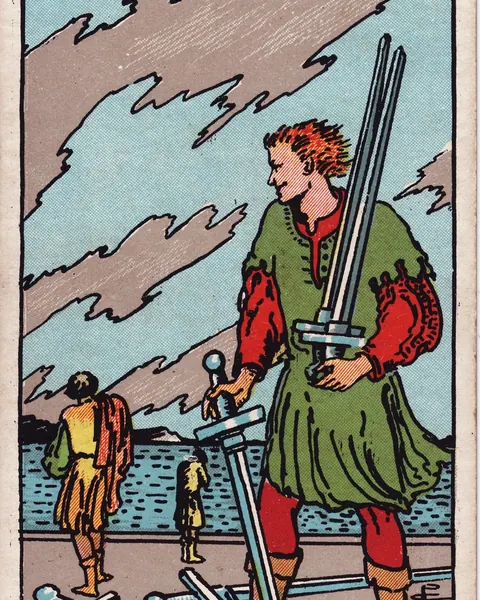
The Rider–Waite–Smith Five of Swords is set on an open shore under a sky torn by jagged, wind-driven clouds. In the foreground a young man with a faint, knowing smile holds three swords, two resting on his shoulder and one pointed at the ground. Two more swords lie on the earth at his feet. Behind him, two figures walk away towards the water. One has his face in his hands; the other looks down, turned away from the scene.
Nothing in the picture is violent in itself. What it shows is the moment just after a dispute, when one side has collected the prizes and the other has given up. The question the card raises is not who was right but what everyone has lost along the way. The ragged sky suggests that the atmosphere has been disturbed, and it will take time for the air to settle.
- The man holding three swords: the side that has come out on top, perhaps a little too pleased with the result.
- The two swords on the ground: what has been dropped or surrendered, including goodwill and trust.
- The two departing figures: people who have walked away from the contest, tired or hurt rather than defeated in any lasting sense.
- The torn clouds: a mood unsettled by tension and sharp words.
- The open shore and distant water: the wider perspective still available once tempers cool.
- The faint smile: the satisfaction of winning, and the quiet question of whether it is worth the cost.
Upright
Upright, the Five of Swords describes conflict in which winning and losing get tangled up. It might be an argument with a partner, a dispute among friends or colleagues, or a competitive situation where someone has pushed a little too hard. The card often appears when pride is involved, and when the need to be right has begun to matter more than the relationship or the actual goal.
If you are on the winning side, the card asks you to consider the cost. Did you get your way at the expense of trust or cooperation? Sometimes the most graceful move is to let go of a point, apologise for a sharp remark or share the credit. If you feel you have lost, the card offers a different comfort: walking away from a fight that cannot be won fairly is not weakness. Choosing your battles is a form of wisdom.
The Five can also describe situations where people are not playing fairly, and it encourages appropriate caution. That does not mean assuming the worst about everyone. It means paying attention to boundaries, keeping agreements clear and not being drawn into contests that only drain your energy.
Reversed
Reversed, the Five of Swords often shows a conflict winding down. Tempers cool, people are ready to talk, and there is room for apology or compromise. Someone may reach out first, or both sides may simply realise that the argument is no longer worth carrying. This is a hopeful turn: the swords are being laid down.
The reversal can also point to resentment that lingers after the dispute has officially ended. Things may look settled on the surface while hurt feelings remain underneath. If so, a quiet, honest conversation, or simply giving each other time, can help the residue fade. In some readings, it also suggests stepping away from a competitive environment altogether because it no longer fits who you are.
Love
In love, the Five of Swords usually points to friction: arguments that go round in circles, a competitive streak between partners or words said in the heat of the moment. It does not mean the relationship is doomed. It invites both people to remember they are on the same team, and to swap the question of who is right for the question of what you both need.
The card can also highlight unhealthy dynamics such as point-scoring or game-playing. Noticing them is the first step towards a kinder way of relating.
| Situation | Upright | Reversed |
|---|---|---|
| Single | Watch for dating dynamics that feel like a contest, or for old resentments shaping how you meet new people. Ease and kindness count for more than winning. | You are ready to let go of past bitterness. Releasing an old grievance makes room for healthier connections. |
| In a relationship | An argument may have left one of you feeling defeated. Rather than replaying who said what, look for the need underneath the disagreement. | The two of you are ready to make peace. A sincere apology or a small compromise can go a long way. |
| Reconciliation & breakups | The end of the relationship may still feel like a battle. Before thinking about reconnecting, let the emotional dust settle. | Hostility softens and it becomes possible to talk calmly, whether to reconcile or to part on better terms. |
Money
In money matters, the Five of Swords can point to disputes over shared costs, unclear agreements or a deal in which one side gained more than was fair. It encourages you to read terms carefully, keep records and avoid being pressured into quick decisions. If something seems one-sided, it is reasonable to ask questions.
It can also warn against financial competitiveness, such as spending to keep up with others or trying to win back losses quickly. Reversed, it suggests that a disagreement about money can now be resolved, or that it is time to walk away from an arrangement that is not working. For legal or financial disputes of any size, seek advice from a qualified professional rather than relying on a card.
Career & study
At work, the Five of Swords may describe office politics, a tense meeting or rivalry between colleagues. You might win an argument but lose goodwill, or feel that someone else took credit unfairly. The card suggests focusing on what actually moves the work forward. Clear communication, written agreements and a calm tone tend to protect you better than trying to out-argue everyone.
In study, it can reflect competitive pressure or friction within a group project. Concentrate on your own progress rather than comparing yourself constantly with others, and if a group dynamic is unfair, raise it calmly with the person responsible.
Reversed, the card shows tensions easing at work, or a sensible decision to step back from a conflict that cannot be won. Leaving a draining situation is sometimes the most professional move available.
As your card of the day
If the Five of Swords is your card of the day, pick your battles carefully. Small disagreements may feel bigger than usual, and it may be tempting to get the last word. Ask yourself whether the point really matters before you push it.
If tension does arise, aim for a solution rather than a victory. Letting someone else be right about something minor can leave you with more peace and energy for what does matter.
- Try: pausing before replying in a heated conversation, clarifying expectations in writing, and taking a short walk to cool off if needed.
- Go easy on: sarcasm, point-scoring and competitive comparisons on social media.
- One-line advice: a win that costs a friendship is rarely a win.
Card combinations
- Five of Swords + The Tower: conflicts that have been building come into the open all at once. Startling, perhaps, but problems that are visible can finally be solved.
- Five of Swords + Justice: a dispute that needs to be settled fairly. Rely on facts and records rather than emotion.
- Five of Swords + Two of Cups: the possibility of reconciliation after an argument. Open hearts can reconnect.
- Five of Swords + Seven of Swords: strategy and suspicion mixed together. Act honestly, and check that you are not being overly distrustful of others.
- Five of Swords + Six of Swords: leaving the battlefield behind and heading somewhere calmer.
The number 5 in the suit of Swords
Fives disrupt the stability of the fours. In the Five of Wands there is lively competition, in the Five of Cups grief over spilled hopes, and in the Five of Pentacles a time of hardship. In the Five of Swords the disruption comes through words and wills clashing. After the quiet rest of the Four, the mind returns to the world and immediately meets other minds with different agendas.
The Golden Dawn named this card the Lord of Defeat and assigned it to Venus in the first decan of Aquarius. Venus seeks harmony and connection, while Aquarius values independence and ideas. When the two pull against each other, relationships can strain under the weight of principle and pride. Read this way, the card is not about cruelty but about the cost of putting being right above being together. The next card, the Six of Swords, shows the way forward: moving away from the conflict towards calmer water.